Saturday, May 24, 2008

Feast of the Divine Body of Christ

On the Thursday after the Feast of All Saints (Sunday after Pentecost) many Byzantine Churches celebrate the Feast of the Divine Body and Blood of our Lord. While this Feast has its origin in the West, where it is known as Corpus Christi, devotion to our Lord in the Reserved Sacrament also grew in importance in the East. By the eighteenth century, the Melkite and Ukrainian Greek Catholic traditions had firmly fixed the celebration as a joyous time of adoration and devotion to our Lord's Incarnation and the great Mystery of His Body and Blood which we receive at every Divine Liturgy. In current practice, it is celebrated on the aforementioned Thursday or the Sunday after All Saints.

Since the Second Vatican Council, some in the Byzantine Churches have downplayed the importance of the Feast, even going so far as claiming that it should be suppressed as a "Roman innovation". This reflects and unfortunate misunderstanding of the Eastern mind and history. While it is wholly appropriate to embrace the fullness of our Eastern Tradition, we must be careful to distinguish between Western-influenced accretions and organic Byzantine developments that are coherent with our faith and customs, even if we find no counterpart to them in the practices of our Separated Brethren. The historic lateness of the development of a particular devotion or celebration is no argument against its orthodoxy. If it were, we would have to reconsider cherished customs such as the Iconistasion, administering Holy Communion via the spoon, Tabernacles on the Altar, etc..

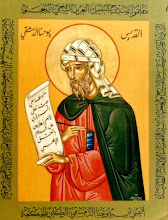
The Church is One in confessing the real Sacramental presence of our Lord Jesus Christ in the sacrifice of the Divine Liturgy. The prayers, ritual actions, and devotions of the Divine Liturgy clearly indicate that the Bread and Wine become no less than the Body and Blood of our Lord. Iconography depicts the reality of this Mystical Gift in many ways, including our Lord situated in the Communion Chalice. St John of Damascus, as one example among many, discusses the reality of our Lord's Sacramental presence in his masterful refutation of the iconoclasts. It is meet to cherish this beautiful celebration.

Here are the Aposticha in Tone Six (Plagal of the Second) of the Great Vespers and the Troparion and Kontakion for the Feast.

Heavenly Bread who so generously satisfy with the wealth of Your goods those who hunger for justice: bestow Your grace upon us who now adore You, and save our souls!

Verse: Taste and see how good the Lord is; blessed are those who trust in Him.

Divine Food, Wheat of the Elect who feed with heavenly Grace the souls of those who receive You: inflame our hearts and spirits with the Fire of Your Divine Love for the salvation of our souls.

Verse: I will take the chalice of Salvation and call upon the Name of the Lord.

Most Holy Wine who nurture virgins by pouring the grace of sanctification upon the souls of those who partake of You: cleanse our hearts of every sin, make them holy, and save our souls.

Verse: Glory to the Father and to the Son and to the Holy Spirit.

Lamb of God who take away the sins of the world, You move the hearts of all the faithful: they adore You deeply and reverently as they look upon You lifted up in the hands of Your holy priests. Together with the angels, they offer a hymn of praise to Your glory, crying out: O Lord, Life Itself, eternally living with Your Father and Your Holy Spirit: glory to You!

Verse: Now and ever and unto ages of ages. Amen.

All the virgins come to you, Holy City of undisturbed purity, whose holy womb contained the King of Kings, from whose blood the Holy Spirit wove the porphyry robe of Christ Emmanuel, the One we now adore hidden in the Mystic Bread. O you who gave birth to the Incarnate God, intercede with Him for the salvation of our souls!

Troparion of the Divine Body in Tone One

Christ, having loved His own and loved them until the end, gave them His Body and His Blood as food and drink. Therefore, let us offer them adoration and say with fear: Glory to Your Presence, O Christ! Glory to Your Compassion! Glory to Your Condescension, for You alone are the Lover of Mankind!

Kontakion of the Divine Body in Tone Two

O Christ, do not turn Your Face away from me when I partake of the Bread which is Your Body and the Wine which is Your Blood. O Lord, let my sharing in these august Mysteries be not for my judgment or condemnation, but for my eternal and everlasting life.
May the Mystical Presence of our Lord in His Body and Blood lead us all in humility to repentance, forgiveness, and the Unity to which He calls us. Amen.

Wednesday, May 21, 2008

From the Historic Annals of World War II

Kalimafi tip to Fr Z


Keep liquid away from your mouth when watching this.

(Some people have way TOO MUCH time on their hands; thank God!)

Interesting Stuff from MercatorNet

Three snippets from three thought provoking essays over at MercatorNet.

We live in an age in which the media are scrupulously rigorous in self-censoring when it comes to the terrible social crime of offending women, gays, people of colour and natives. Only one identifiable group – white heterosexual men (if they’re Christian, so much the better) – is considered fair game for overt collective prejudice.

Identifying active misandry is easy. One has only to imagine the same words, image or falsehood or failure to report attached to any other identifiable group, and the imbalance becomes clear.
From Misandry is the Message.

The state must hold that mothers and fathers are completely interchangeable. Biological parents married to each other become officially equivalent to one parent plus their lover. The state will be indifferent as to whether children have any connection with their biological parents.
From Beyond Same Sex Marriage.

While “human dignity” is an idea which certainly requires extensive clarification and precise definition, “respect for persons” and “autonomy” are as squishy as a wet sponge. I would have thought that a Harvard prof would be more discerning. For instance, are dolphins or chimpanzees “persons”, too? Should Japanese fishermen be jailed for violating the person rights of minke whales? And is a sleeping person autonomous? A comatose person? A two-day-old infant?
Note: This essay's links also reward pursuit.

From Human Dignity, What a Stupid Idea!

 
.......