Synaxarion
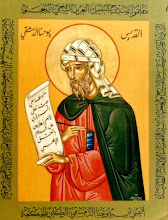
On 31 January, we commemorate the holy martyrs, the monyless wonderworkers Cyrus and John, the holy martyred woman Athanasia and her daughters, the virgins Theodota, Theoctista, and Eudoxia.
Together they experienced the blow of the sword; together they work miracles: Cyrus and John! Under the same sword, a wondrous mother and her three daughters died for their God and Father. At the hands of the execution, the iron cut short the life of Cyrus and John on the thirty-first of January.
By their holy prayers, O our God, have mercy on us and save us. Amen.
Thursday, January 31, 2008


Wednesday, January 30, 2008
From the Menaion - 30 January
Synaxarion
On 30 January, we commemorate our Fathers among the Saints, the great Ecumenical Teachers and Hierarchs, Basil the Great, Gregory the Theologian and John Chrysostom.
Three stars: it was just to bring them together: their lives radiate a light of triple brilliance. It should be a common praise that we offer to those who have offered the same grace to all. One swallow alone does not make the springtime: three holy ones together bring about the springtime of our souls. The Trinity shines upon the intelligent world; this trio illuminates the visible world. The ancients destroyed the worship of the True God: their sun and moon engendered only darkness. Admiring their splendor with too much haste, they adored their borrowed flame. But by these three torches, their embers were extinguished. They returned us to the True Faith. The beauty of their lives and their holy eloquence made us worship the only Providence. Fire and water, earth and air constitute reality for our earthly eyes. But they, by uniting the great, vast world to our faith in God, showing a new creation based on both, have imitated in themselves the Three Elements of the only Trinity. They have not prepared a cure from any earthly things; there is no worldly spirit in their writings. The word of Gregory is breath of fire; it is his intent to make us run to things on high. The word of Basil brings back a breath of health to those weakened by unhealthy passions. Like the flow of the waters of a river, the words of Chrysostom go straight to the heart to refresh those consumed by burning passions. Thus, by their words, human nature is lifted up from the depths to unheard of heights. On the thirtieth, their triple light shines forth!
On this same day, we commemorate the passion of the holy Hieromartyr Hippolytus, Pope of Rome, and his companions Censures, Sabainos, Chrysa and others.
Valiantly Hippolytus plunged into the water, like a horse enjoying a full gallop on the plain. Censures presented his head to the sword as a polishing stone for his fellow athletes. The sons of darkness, the heartless executioners, burnt the entrails of the victorious Sabainos. Chrysa, thrown into the waters, went freshly bathed as a new bride into the heavenly wedding changer. Hippolytus entered the heavenly fish pond when he was plunged under the dark waters on the thirtieth of January.
By their holy prayers, O our God, have mercy on us and save us. Amen.
On 30 January, we commemorate our Fathers among the Saints, the great Ecumenical Teachers and Hierarchs, Basil the Great, Gregory the Theologian and John Chrysostom.
Three stars: it was just to bring them together: their lives radiate a light of triple brilliance. It should be a common praise that we offer to those who have offered the same grace to all. One swallow alone does not make the springtime: three holy ones together bring about the springtime of our souls. The Trinity shines upon the intelligent world; this trio illuminates the visible world. The ancients destroyed the worship of the True God: their sun and moon engendered only darkness. Admiring their splendor with too much haste, they adored their borrowed flame. But by these three torches, their embers were extinguished. They returned us to the True Faith. The beauty of their lives and their holy eloquence made us worship the only Providence. Fire and water, earth and air constitute reality for our earthly eyes. But they, by uniting the great, vast world to our faith in God, showing a new creation based on both, have imitated in themselves the Three Elements of the only Trinity. They have not prepared a cure from any earthly things; there is no worldly spirit in their writings. The word of Gregory is breath of fire; it is his intent to make us run to things on high. The word of Basil brings back a breath of health to those weakened by unhealthy passions. Like the flow of the waters of a river, the words of Chrysostom go straight to the heart to refresh those consumed by burning passions. Thus, by their words, human nature is lifted up from the depths to unheard of heights. On the thirtieth, their triple light shines forth!
On this same day, we commemorate the passion of the holy Hieromartyr Hippolytus, Pope of Rome, and his companions Censures, Sabainos, Chrysa and others.
Valiantly Hippolytus plunged into the water, like a horse enjoying a full gallop on the plain. Censures presented his head to the sword as a polishing stone for his fellow athletes. The sons of darkness, the heartless executioners, burnt the entrails of the victorious Sabainos. Chrysa, thrown into the waters, went freshly bathed as a new bride into the heavenly wedding changer. Hippolytus entered the heavenly fish pond when he was plunged under the dark waters on the thirtieth of January.
By their holy prayers, O our God, have mercy on us and save us. Amen.
Tuesday, January 29, 2008
Fr Oakes, Atheism and Violence
A hat tip to Amy Wellborn for referencing the On the Square article by Edward T. Oakes, S.J. over at First Things. The article is entitled, "Atheism and Violence." Here are a couple of excerpts to whet your whistle. Then go read the article.
Find the article here.
One would think that, given their insistence that faith and violence are inextricably linked, these authors would be a bit more circumspect about their own rhetoric. As it happens, one does not have to read too far into these books to see an underlying advocacy of violence animating their venom, an advocacy made most explicit in Sam Harris’s The End of Faith, which openly avows: “Some propositions are so dangerous that it may even be ethical to kill people for believing them. This may seem an extraordinary claim, but it merely enunciates an ordinary fact about the world in which we live. . . . There is, in fact, no talking to some people. … We will continue to spill blood in what is, at bottom, a war of ideas.” To which I can only respond with one of Blaise Pascal’s more mordant observations, “Thinking too little about things or thinking too much both make us obstinate and fanatical.” Pascal called civil war the worst of all evils and openly admitted that no evil is greater than that committed under the guise of religion. If he were living today, I am sure his response to Harris would be: yes, Mr. Harris, you’re right, and the reason atheism brings so much violence in its wake is because it is its own kind of religion—and that’s your problem: your atheism is too religious.
...
Such are the contradictions of atheism. With hope in progress gone, with the lessons of the twentieth century still unlearned in the twenty-first, with technology progressing, in Adorno’s words, from the slingshot to the atom bomb (a remark cited in Spe Salvi), with a resurgence of religiously motivated violence filling the headlines, all that the new atheists can manage is to hearken back to an Enlightenment-based critique of religion. But they find their way blocked, not so much by Nietzsche (whom, as we saw, they largely ignore) but by the ineluctable realities he so ruthlessly exposed. Not Nietzsche, but the history of the twentieth century has shown that godless culture is incapable of making men happier. All Nietzsche did was to point out that no civilization, however “progressive,” can dispel the terrifying character of nature; and once progress is called into question, the human condition appears in all its forsaken nakedness.
Find the article here.
From the Menaion - 29 January
Synaxarion
On 29 January, we commemorate the transfer of the relics of the holy Hieromartyr Ignatios, the God-bearer.
A part of your body was preserved, O Ignatios. The faithful give thanks that the devouring lions spared these renowned relics. On the twenty-ninth, Ignatios made his return to his See.
By his holy prayers, O our God, have mercy on us and save us. Amen.
On 29 January, we commemorate the transfer of the relics of the holy Hieromartyr Ignatios, the God-bearer.
A part of your body was preserved, O Ignatios. The faithful give thanks that the devouring lions spared these renowned relics. On the twenty-ninth, Ignatios made his return to his See.
By his holy prayers, O our God, have mercy on us and save us. Amen.
Monday, January 28, 2008
Memory Eternal - Sayidna Christodoulos falls asleep
News reports this morning announce that the Archbishop of Athens Christodoulos has fallen asleep in the Lord at 69 years of age.
May his memory be eternal!
May his memory be eternal!
From the Menaion - 28 January
Synaxarion
On 28 January, we commemorate our venerable father Ephrem the Syrian.
Ephrem, a Syrian by race and tongue, heard an unknown language, as the psalm says, calling him to the heights. On January twenty-eighth, the Angels led him up to sing his praises before God.
By his holy prayers, O our God, have mercy on us and save us. Amen.
On 28 January, we commemorate our venerable father Ephrem the Syrian.
Ephrem, a Syrian by race and tongue, heard an unknown language, as the psalm says, calling him to the heights. On January twenty-eighth, the Angels led him up to sing his praises before God.
By his holy prayers, O our God, have mercy on us and save us. Amen.
Sunday, January 27, 2008
Synaxarion - Sunday of the Last Judgment (Meatfare)
FROM THE TRIODION
IKOS
O Lord, supreme in love, as I reflect upon Your awesome judgment seat and the Day of Judgment, I tremble and am filled with fear, for my own conscience accuses me. When you are seated on Your throne and bring all for examination, no one will then be able to deny their sins, for the truth will accuse them and terror hold them back. The flames of Gehenna will roar and sinners will gnash their teeth. Therefore have mercy on me before the end, O Righteous Judge, deliver me from the unquenchable fire, and make me worthy to stand at Your right.
SYNAXARION
On this day, we commemorate the Second Coming of our Lord Jesus Christ, the Last Judge.
When You are seated upon Your throne to judge the whole world, O Just and Righteous Judge, make me also worthy to hear You say: “Come!”
Wherefore, in the abundance of Your ineffable compassion, O Christ our God, make us worthy to hear Your glorious voice and number us among those who stand at Your right Hand. Amen.
IKOS
O Lord, supreme in love, as I reflect upon Your awesome judgment seat and the Day of Judgment, I tremble and am filled with fear, for my own conscience accuses me. When you are seated on Your throne and bring all for examination, no one will then be able to deny their sins, for the truth will accuse them and terror hold them back. The flames of Gehenna will roar and sinners will gnash their teeth. Therefore have mercy on me before the end, O Righteous Judge, deliver me from the unquenchable fire, and make me worthy to stand at Your right.
SYNAXARION
On this day, we commemorate the Second Coming of our Lord Jesus Christ, the Last Judge.
When You are seated upon Your throne to judge the whole world, O Just and Righteous Judge, make me also worthy to hear You say: “Come!”
Wherefore, in the abundance of Your ineffable compassion, O Christ our God, make us worthy to hear Your glorious voice and number us among those who stand at Your right Hand. Amen.
From the Menaion - 27 January
Synaxarion
On 27 January, we commemorate the transfer of the remains of our Father among the Saints, John Chrysostom, Archbishop of Constantinople.
Although dead, you still occupy the throne of a bishop. Alive in God, you still say, "Pease to all" from Heaven. On the twenty-seventh, Byzantium received your body in a golden reliquary with reverent respect.
By his holy prayers, O our God, have mercy on us and save us. Amen.
On 27 January, we commemorate the transfer of the remains of our Father among the Saints, John Chrysostom, Archbishop of Constantinople.
Although dead, you still occupy the throne of a bishop. Alive in God, you still say, "Pease to all" from Heaven. On the twenty-seventh, Byzantium received your body in a golden reliquary with reverent respect.
By his holy prayers, O our God, have mercy on us and save us. Amen.
Saturday, January 26, 2008
Hymns and Readings - Sunday of the Last Judgment
27 January 2008
Meatfare Sunday
Commemoration of Transfer of the Relics of St John Chrysostom
Tone Two — Eothinon Four
TROPARIA AND KONTAKION
(Theme hymns of the day and concluding seasonal hymns)
TROPARION OF THE RESURRECTION IN TONE TWO
When You descended to death, O immortal Life, You destroyed Hades by the splendor of Your divinity, and when You raised the dead from below the earth, all the heavenly powers cried out to You: O Giver of Life, Christ our God, glory to You.
TROPARION OF ST JOHN CHRYSOSTOM IN TONE EIGHT
The Grace that shines forth from your mouth like a torch has enlightened the universe, bestowed treasures of generosity upon the world, and shown us the heights of humility. While you teach us through your words, pray to the Word, Christ our God, that He may save our souls.
KONTAKION OF THE LAST JUDGMENT IN TONE ONE
O God, when You shall come down upon earth in your glory, every creature shall tremble before You. A river of fire shall flow before your judgment-seat, the books shall be opened and all secrets revealed. On that day, O Just Judge, deliver me from eternal fire and make me worthy to stand at your right.
KONTAKION OF THE PRESENTATION OF CHRIST IN TONE ONE
O Christ our God who through your birth have sanctified the virginal womb and have now blessed the arms of Simeon, today You have come to save us. O Lord, when wars prevail, keep your people in peace and strengthen our Public Authorities in every good deed, for You alone are the Lover of Mankind.
LITURGY OF THE WORD
PROKIMENON
(Responsory from the Psalter)
My mouth shall speak wisdom;
the meditation of my heart shall be understanding.
Hear this, all peoples! Give ear, all inhabitants of the world
THE READING FROM THE EPISTLE TO THE HEBREWS
BRETHREN: It was fitting that we should have such a high priest, holy, blameless, unstained, separated from sinners, exalted above the heavens. He has no need, like those high priests, to offer sacrifices daily, first for his own sins and then for those of the people; he did this once for all when he offered up himself. Indeed, the law appoints men in their weakness as high priests, but the word of the oath, which came later than the law, appoints a Son who has been made perfect for ever. Now the point in what we are saying is this: we have such a high priest, one who is seated at the right hand of the throne of the Majesty in heaven, a minister in the sanctuary and the true tent which is set up not by man but by the Lord.
ALLELUIA
The mouth of the righteous utters wisdom,
and his tongue speaks justice.
The law of his God is in his heart;
his steps do not slip.
THE READING FROM THE HOLY GOSPEL ACCORDING TO ST MATTHEW
THE LORD SAID: When the Son of Man comes in his glory, and all the angels with him, then he will sit on his glorious throne. Before him will be gathered all the nations, and he will separate them one from another as a shepherd separates the sheep from the goats, and he will place the sheep at his right hand, but the goats at the left. Then the King will say to those at his right hand, ‘Come, O blessed of my Father, inherit the kingdom prepared for you from the foundation of the world; for I was hungry and you gave me food, I was thirsty and you gave me drink, I was a stranger and you welcomed me, I was naked and you clothed me, I was sick and you visited me, I was in prison and you came to me.' Then the righteous will answer him, ‘Lord, when did we see thee hungry and feed thee, or thirsty and give thee drink? And when did we see thee a stranger and welcome thee, or naked and clothe thee? And when did we see thee sick or in prison and visit thee?' And the King will answer them, ‘Truly, I say to you, as you did it to one of the least of these my brethren, you did it to me.' Then he will say to those at his left hand, ‘Depart from me, you cursed, into the eternal fire prepared for the devil and his angels; for I was hungry and you gave me no food, I was thirsty and you gave me no drink, I was a stranger and you did not welcome me, naked and you did not clothe me, sick and in prison and you did not visit me.' Then they also will answer, ‘Lord, when did we see thee hungry or thirsty or a stranger or naked or sick or in prison, and did not minister to thee?' Then he will answer them, ‘Truly, I say to you, as you did it not to one of the least of these, you did it not to me.’ And they will go away into eternal punishment, but the righteous into eternal life.
HIRMOS IN TONE FIVE
(A “Megalynarion” — Hymn to the Virgin — sung after the Consecration)
It is truly meet to bless you, O Theotokos, who are ever-blessed and all-blameless and the Mother of our God; more honored than the Cherubim and more glorious beyond compare than the Seraphim: You who without stain did bear God the Word and are truly Theotokos: we magnify you.
COMMUNION HYMN
Refrain: Praise the LORD! Praise the LORD from the heavens,
Praise him in the heights!
Verse1: For the righteous will never be moved;
he will be remembered for ever.
Verse2: He is not afraid of evil tidings;
his heart is firm, trusting in the LORD.
Meatfare Sunday
Commemoration of Transfer of the Relics of St John Chrysostom
Tone Two — Eothinon Four
TROPARIA AND KONTAKION
(Theme hymns of the day and concluding seasonal hymns)
TROPARION OF THE RESURRECTION IN TONE TWO
When You descended to death, O immortal Life, You destroyed Hades by the splendor of Your divinity, and when You raised the dead from below the earth, all the heavenly powers cried out to You: O Giver of Life, Christ our God, glory to You.
TROPARION OF ST JOHN CHRYSOSTOM IN TONE EIGHT
The Grace that shines forth from your mouth like a torch has enlightened the universe, bestowed treasures of generosity upon the world, and shown us the heights of humility. While you teach us through your words, pray to the Word, Christ our God, that He may save our souls.
KONTAKION OF THE LAST JUDGMENT IN TONE ONE
O God, when You shall come down upon earth in your glory, every creature shall tremble before You. A river of fire shall flow before your judgment-seat, the books shall be opened and all secrets revealed. On that day, O Just Judge, deliver me from eternal fire and make me worthy to stand at your right.
KONTAKION OF THE PRESENTATION OF CHRIST IN TONE ONE
O Christ our God who through your birth have sanctified the virginal womb and have now blessed the arms of Simeon, today You have come to save us. O Lord, when wars prevail, keep your people in peace and strengthen our Public Authorities in every good deed, for You alone are the Lover of Mankind.
LITURGY OF THE WORD
PROKIMENON
(Responsory from the Psalter)
My mouth shall speak wisdom;
the meditation of my heart shall be understanding.
Hear this, all peoples! Give ear, all inhabitants of the world
THE READING FROM THE EPISTLE TO THE HEBREWS
BRETHREN: It was fitting that we should have such a high priest, holy, blameless, unstained, separated from sinners, exalted above the heavens. He has no need, like those high priests, to offer sacrifices daily, first for his own sins and then for those of the people; he did this once for all when he offered up himself. Indeed, the law appoints men in their weakness as high priests, but the word of the oath, which came later than the law, appoints a Son who has been made perfect for ever. Now the point in what we are saying is this: we have such a high priest, one who is seated at the right hand of the throne of the Majesty in heaven, a minister in the sanctuary and the true tent which is set up not by man but by the Lord.
ALLELUIA
The mouth of the righteous utters wisdom,
and his tongue speaks justice.
The law of his God is in his heart;
his steps do not slip.
THE READING FROM THE HOLY GOSPEL ACCORDING TO ST MATTHEW
THE LORD SAID: When the Son of Man comes in his glory, and all the angels with him, then he will sit on his glorious throne. Before him will be gathered all the nations, and he will separate them one from another as a shepherd separates the sheep from the goats, and he will place the sheep at his right hand, but the goats at the left. Then the King will say to those at his right hand, ‘Come, O blessed of my Father, inherit the kingdom prepared for you from the foundation of the world; for I was hungry and you gave me food, I was thirsty and you gave me drink, I was a stranger and you welcomed me, I was naked and you clothed me, I was sick and you visited me, I was in prison and you came to me.' Then the righteous will answer him, ‘Lord, when did we see thee hungry and feed thee, or thirsty and give thee drink? And when did we see thee a stranger and welcome thee, or naked and clothe thee? And when did we see thee sick or in prison and visit thee?' And the King will answer them, ‘Truly, I say to you, as you did it to one of the least of these my brethren, you did it to me.' Then he will say to those at his left hand, ‘Depart from me, you cursed, into the eternal fire prepared for the devil and his angels; for I was hungry and you gave me no food, I was thirsty and you gave me no drink, I was a stranger and you did not welcome me, naked and you did not clothe me, sick and in prison and you did not visit me.' Then they also will answer, ‘Lord, when did we see thee hungry or thirsty or a stranger or naked or sick or in prison, and did not minister to thee?' Then he will answer them, ‘Truly, I say to you, as you did it not to one of the least of these, you did it not to me.’ And they will go away into eternal punishment, but the righteous into eternal life.
HIRMOS IN TONE FIVE
(A “Megalynarion” — Hymn to the Virgin — sung after the Consecration)
It is truly meet to bless you, O Theotokos, who are ever-blessed and all-blameless and the Mother of our God; more honored than the Cherubim and more glorious beyond compare than the Seraphim: You who without stain did bear God the Word and are truly Theotokos: we magnify you.
COMMUNION HYMN
Refrain: Praise the LORD! Praise the LORD from the heavens,
Praise him in the heights!
Verse1: For the righteous will never be moved;
he will be remembered for ever.
Verse2: He is not afraid of evil tidings;
his heart is firm, trusting in the LORD.
From the Triodion - Saturday of the Dead
The Day before the Sunday of the Last Judgment (Meatfare)
Troparion of the Dead in Tone Eight
Unique Creator, Lord, who in the depth of Your wisdom and love for mankind direct us all, giving to each one what is good for salvation: grant rest to the souls of Your servants, for they have put their trust in You, our creator, Maker and God.
Kontakion of the Dead in Tone Eight
O Christ our God, with the Saints, grant rest to the souls of Your servants in a place where there is no pain, no grief, no sighing, but everlasting life.
Ikos
You are the only Immortal One, O Creator and Maker of man. We are mortals: out of the earth we were fashioned and to the same earth we shall return, as You have said and ordered, O my Maker: "Dust you are," said You, "and to dust you shall return." We all go down to the dust and we sing to you: Alleluia!
Synaxarion
On this day, the holy Fathers established a memorial for all those who have fallen asleep throughout the ages in faith and in the hope of everlasting life.
Remember not the transgressions of the dead, O Timeless Word: let not Your great tenderness and compassion be seen to be inactive.
Wherefore, O Christ our Lord, grant rest in the dwelling-place of the just to the souls who have fallen asleep before us and have mercy on us, for Your alone are deathless. Amen.
Troparion of the Dead in Tone Eight
Unique Creator, Lord, who in the depth of Your wisdom and love for mankind direct us all, giving to each one what is good for salvation: grant rest to the souls of Your servants, for they have put their trust in You, our creator, Maker and God.
Kontakion of the Dead in Tone Eight
O Christ our God, with the Saints, grant rest to the souls of Your servants in a place where there is no pain, no grief, no sighing, but everlasting life.
Ikos
You are the only Immortal One, O Creator and Maker of man. We are mortals: out of the earth we were fashioned and to the same earth we shall return, as You have said and ordered, O my Maker: "Dust you are," said You, "and to dust you shall return." We all go down to the dust and we sing to you: Alleluia!
Synaxarion
On this day, the holy Fathers established a memorial for all those who have fallen asleep throughout the ages in faith and in the hope of everlasting life.
Remember not the transgressions of the dead, O Timeless Word: let not Your great tenderness and compassion be seen to be inactive.
Wherefore, O Christ our Lord, grant rest in the dwelling-place of the just to the souls who have fallen asleep before us and have mercy on us, for Your alone are deathless. Amen.
From the Menaion - 26 January
Synaxarion
On 26 January, we commemorate our venerable father Xenophon, his wife Mary, and their sons Arcadios and John.
To celebrate their departure, I offer a song as refreshment at my table to Xenophon and his sons and wife, a venerable family. He died on the twenty-sixth, but in Heaven he was joined by his wife and sons.
By their holy prayers, O our God, have mercy on us and save us. Amen.
On 26 January, we commemorate our venerable father Xenophon, his wife Mary, and their sons Arcadios and John.
To celebrate their departure, I offer a song as refreshment at my table to Xenophon and his sons and wife, a venerable family. He died on the twenty-sixth, but in Heaven he was joined by his wife and sons.
By their holy prayers, O our God, have mercy on us and save us. Amen.
Friday, January 25, 2008
Ajami on Huntington
Hat tip to Done with Mirrors for this New York Times essay by Fouad Ajami on Samuel P Huntington. If you don't know who Huntington is or why you should known him, go here, here, and here.
In the meantime, here's just one paragraph from Ajami's essay:
Order the book, The Clash of Civilizations and the Remaking of World Order, here.
In the meantime, here's just one paragraph from Ajami's essay:
In Huntington’s unsparing view, culture is underpinned and defined by power. The West had once been pre-eminent and militarily dominant, and the first generation of third-world nationalists had sought to fashion their world in the image of the West. But Western dominion had cracked, Huntington said. Demography best told the story: where more than 40 percent of the world population was “under the political control” of Western civilization in the year 1900, that share had declined to about 15 percent in 1990, and is set to come down to 10 percent by the year 2025. Conversely, Islam’s share had risen from 4 percent in 1900 to 13 percent in 1990, and could be as high as 19 percent by 2025.Read the entire essay here. Then email it to a friend.
Order the book, The Clash of Civilizations and the Remaking of World Order, here.
In other Patriarchal News...
From Interfax.
The Moscow Patriarchate criticizes ‘politically correct’ Christianity
Vienna, January 22, Interfax - The Russian Orthodox Church's representative to the European International Institutions believes it important to preserve Christian traditions in today’s liberal world.
‘Christianity, empty inside, lacking inner power, Christianity that has renounced itself, will not be able to oppose challenges of the modern world,’ Bishop Hilarion of Vienna and Austria said at a meeting organized by the Ecumenical Council of Churches in Austria dedicated to its 50th anniversary.
The Russian Church’s representative stressed that ‘we should be afraid of giving up spiritual and moral teaching accumulated by the Christian Church for centuries and surrender to the influence of liberal ideas and secular moral standards.’
‘When some Christian communities start revising theological or moral teaching of Christianity in order to ‘update’ it or to make it more ‘politically correct’, it is a direct way to spiritual collapse,’ the bishop added.
According to him, ‘Christians are powerful only when they follow the testament of Christ rather than when they start building their life by the rules of secular world.’
The Moscow Patriarchate criticizes ‘politically correct’ Christianity
Vienna, January 22, Interfax - The Russian Orthodox Church's representative to the European International Institutions believes it important to preserve Christian traditions in today’s liberal world.
‘Christianity, empty inside, lacking inner power, Christianity that has renounced itself, will not be able to oppose challenges of the modern world,’ Bishop Hilarion of Vienna and Austria said at a meeting organized by the Ecumenical Council of Churches in Austria dedicated to its 50th anniversary.
The Russian Church’s representative stressed that ‘we should be afraid of giving up spiritual and moral teaching accumulated by the Christian Church for centuries and surrender to the influence of liberal ideas and secular moral standards.’
‘When some Christian communities start revising theological or moral teaching of Christianity in order to ‘update’ it or to make it more ‘politically correct’, it is a direct way to spiritual collapse,’ the bishop added.
According to him, ‘Christians are powerful only when they follow the testament of Christ rather than when they start building their life by the rules of secular world.’
Wall Street Reviews Patriarch's Book
This, from the Wall Street Journal: Patriarch Bartholomeos of Constantinople has written a book. The book may be interesting; the review is very interesting. A couple of excerpts follow:
Nowhere does the plight of Christians look so pitiful as in Turkey, nominally secular but 99% Muslim. At the turn of the 20th century, some 500,000 Orthodox Christians, mostly ethnic Greeks, lived in Constantinople, where they constituted half the city's residents, and millions more resided elsewhere in what is now Turkey. Today, Bartholomew has only about 4,000 mostly elderly fellow believers (2,000 in Istanbul) left in Turkey's 71 million-plus population. The quasi-militaristic regime of Kemal Ataturk that supplanted the Ottoman Empire during the 1920s forcibly Westernized the country's institutions but also made Islam an essential component of the Turkish national identity that it relentlessly promoted.Read the whole review here.
...
On first reading, this exercise in fiddling while the new Rome burns seems pathetic, presenting a picture of a church leader so intimidated by his country's Islamic majority that he cannot speak up for his dwindling flock even as its members are murdered at his doorstep. Bartholomew's book presents an eerie mirror image of the concerns of aging, culturally exhausted, post-Christian Western Europe, happy to blather on at conferences about carbon emissions and diversity but unwilling to confront its own demographic crisis in the face of youthful, rapidly growing and culturally antagonistic Muslim populations. The suicide of the West meets the homicide of the East.
From the Menaion - 25 January
Synaxarion
On 25 January, we commemorate our Father among the Saints, Gregory the Theologian, Archbishop of Constantinople.
If the essence of God is known to the Christian in conformity with the Orthodox Faith, it is due to the patrimony bequeathed by Gregory. On the twenty-fifth, Gregory the Theologian died.
By his holy prayers, O our God, have mercy on us and save us. Amen.
On 25 January, we commemorate our Father among the Saints, Gregory the Theologian, Archbishop of Constantinople.
If the essence of God is known to the Christian in conformity with the Orthodox Faith, it is due to the patrimony bequeathed by Gregory. On the twenty-fifth, Gregory the Theologian died.
By his holy prayers, O our God, have mercy on us and save us. Amen.
Thursday, January 24, 2008
From the Menaion - 24 January
Synaxarion
On 24 January, we commemorate our venerable Mother Xenia and her two servants.
Xenia lived as an exile in this world, for she renounced this passing life. Equal are the honors due to her two companions after their deaths, who were not strangers to her virtues. On the twenty-fourth, Xenia, that torch of prayer, was able to find a hospitable homeland in Heaven.
By their prayers, of our God, have mercy on us and save us. Amen.
On 24 January, we commemorate our venerable Mother Xenia and her two servants.
Xenia lived as an exile in this world, for she renounced this passing life. Equal are the honors due to her two companions after their deaths, who were not strangers to her virtues. On the twenty-fourth, Xenia, that torch of prayer, was able to find a hospitable homeland in Heaven.
By their prayers, of our God, have mercy on us and save us. Amen.
Wednesday, January 23, 2008
First Things' On the Square Pallbears
First Things today features a very insightful article in its On the Square section on Pallbears by Rev Paul Gregory Alms, a North Carolina Lutheran pastor. Rev Alms succintly reflects on pallbearing as indicative of the many communal customs and traditions that give meaning and continuity to human life. The piece is called, fittingly, On Being a Pallbearer. Below is an excerpt.
Read the whole article here.
Many customs and traditions in many areas of life are disappearing from among us. Liturgy in the church, national “rites” such as the Pledge of Allegiance or taking off one’s hat at the National Anthem, and countless other shared activities are being lost. There is some advantage to the rejection of a “we’ve always done it that way” mentality. But there is also a danger. More is lost than simple habits. We become more and more isolated, more alone when we mark times and feelings such as birth and marriage and war and patriotism and death in idiosyncratic ways. It becomes “just us” and our decision. Any other greater meaning is gone. When we do things that have always been done, even when it seems antiquated or strange (such as pall bearing), we are affirming that we are not free agents who have landed on the planet in the last twenty years. We have fathers and mothers, grandfathers, great grandmothers, ancestors, who worked and gave birth and believed and raised children, and we are the beneficiaries of that struggle. We have a past to which we are connected through ritual and the shared experience those rituals bring.
Read the whole article here.
From the Menaion - 23 January
Synaxarion
On 23 January, we commemorate the holy hieromartyr Clement, Bishop of Ancyra, and the holy martyr Agathangel.
The blood of Agathangel and Clement slaked the thirst of the bloody sword. On the twenty-third, these martyrs, handed over to the torturers, made up what was lacking in the Passion of Christ.
By the payers of Your saints, O Christ our God, have mercy on us and save us. Amen.
On 23 January, we commemorate the holy hieromartyr Clement, Bishop of Ancyra, and the holy martyr Agathangel.
The blood of Agathangel and Clement slaked the thirst of the bloody sword. On the twenty-third, these martyrs, handed over to the torturers, made up what was lacking in the Passion of Christ.
By the payers of Your saints, O Christ our God, have mercy on us and save us. Amen.
Tuesday, January 22, 2008
From the Menaion - 22 January
Synaxarion
On 22 January, we commemorate the holy apostle Timothy, disciple of the holy apostle Paul.
Desiring a crown, the fervent Timothy dyes the earth with his own blood under the blows of a club. Joined to the Lord, the compassionate God, his soul went up to Heaven on the twenty-second.
On the same day, we commemorate the holy martyred monk Anastasios the Persian.
When the rope was placed around his neck, Anastasios the Persian seemed to be wearing a necklace of inestimable worth. Anastasios endured the rope for the God of tenderness and mercy on the twenty-second.
By their holy prayers, O our God, have mercy on us and save us. Amen.
On 22 January, we commemorate the holy apostle Timothy, disciple of the holy apostle Paul.
Desiring a crown, the fervent Timothy dyes the earth with his own blood under the blows of a club. Joined to the Lord, the compassionate God, his soul went up to Heaven on the twenty-second.
On the same day, we commemorate the holy martyred monk Anastasios the Persian.
When the rope was placed around his neck, Anastasios the Persian seemed to be wearing a necklace of inestimable worth. Anastasios endured the rope for the God of tenderness and mercy on the twenty-second.
By their holy prayers, O our God, have mercy on us and save us. Amen.
Monday, January 21, 2008
From the Menaion - 21 January
Synaxarion
On 21 January, we commemorate our venerable father Maximos the Confessor.
They cut off your hand and your tongue as well, O Maximos. But you allowed yourself to be pruned; and the heavenly Father graciously received your spirit when, on the twenty-first, fate closed your eyes.
On the same day, we commemorate the holy martyr Neophytos.
The lance uprooted from the earth a beautiful young plant, Neophytos, and offshoot of the new Tree of Life.
By the prayers of Your Saints, O Christ our God, have mercy on us and save us. Amen.
On 21 January, we commemorate our venerable father Maximos the Confessor.
They cut off your hand and your tongue as well, O Maximos. But you allowed yourself to be pruned; and the heavenly Father graciously received your spirit when, on the twenty-first, fate closed your eyes.
On the same day, we commemorate the holy martyr Neophytos.
The lance uprooted from the earth a beautiful young plant, Neophytos, and offshoot of the new Tree of Life.
By the prayers of Your Saints, O Christ our God, have mercy on us and save us. Amen.
Sunday, January 20, 2008
From the Menaion - 20 January
Synaxarion
On 20 January, we commemorate our venerable father Euthymios the Great.
What do you have in common with this life? Guide us towards Heaven as we sail through it. Resembling the angels, Euthymios, the gray-headed, became their companion in Heaven on the twentieth.
By his holy prayers, O our God, have mercy on us and save us. Amen.
On 20 January, we commemorate our venerable father Euthymios the Great.
What do you have in common with this life? Guide us towards Heaven as we sail through it. Resembling the angels, Euthymios, the gray-headed, became their companion in Heaven on the twentieth.
By his holy prayers, O our God, have mercy on us and save us. Amen.
Synaxarion - Sunday of the Prodigal Son
FROM THE TRIODION
IKOS
Our Savior teaches us daily with His own words. Let us therefore heed the Scripture lesson of the Prodigal who came to his senses. With faith, let us follow his good example of repentance. With a humble heart, let us cry aloud to Him who knows all secrets: We have sinned against You, O merciful Father! We do not deserve to be called Your children ever again. But since You are the Lover of Mankind, receive me now that I repent and make me as one of Your hired servants!
SYNAXARION
On this day, we commemorate the Parable of the Prodigal Son which occurs in the Holy Gospel, and which our God-bearing Fathers inserted into the Triodion.
Whoever is a Prodigal like me, draw near with confidence and peace. The Gates of the mercy of God have opened to everyone!
By Your ineffable Love for mankind, O Christ our God, have mercy on us and save us. Amen.
IKOS
Our Savior teaches us daily with His own words. Let us therefore heed the Scripture lesson of the Prodigal who came to his senses. With faith, let us follow his good example of repentance. With a humble heart, let us cry aloud to Him who knows all secrets: We have sinned against You, O merciful Father! We do not deserve to be called Your children ever again. But since You are the Lover of Mankind, receive me now that I repent and make me as one of Your hired servants!
SYNAXARION
On this day, we commemorate the Parable of the Prodigal Son which occurs in the Holy Gospel, and which our God-bearing Fathers inserted into the Triodion.
Whoever is a Prodigal like me, draw near with confidence and peace. The Gates of the mercy of God have opened to everyone!
By Your ineffable Love for mankind, O Christ our God, have mercy on us and save us. Amen.
Saturday, January 19, 2008
Hymns and Readings - Sunday of the Prodigal Son
20 January 2008
Sunday of the Prodigal Son
Commemoration of St Euthymios the Great
Tone One - Eothinon Three
Troparia and Kontakion
(Theme hymns of the day and concluding seasonal hymns)
Troparion of the Resurrection in Tone One
While the stone was sealed by the Jews and the soldiers were watching your sacred body, You rose, O Savior, on the third day, giving life to the world. Wherefore, O Giver of life, the Powers of heaven cried out: Glory to your Resurrection, O Christ, glory to your Kingdom, glory to your Plan of Redemption, O, You who alone are the Lover of mankind.
Troparion of Euthymios the Great in Tone Four
Joy to you, barren wilderness, rejoice, sterile desert that never have known the travail of birth, for the man of desires has multiplied your children; he has planted them in devotion and piety and made them grow in detachment for the sake of perfect virtue. Through his supplications, Christ God, give peace to our lives!
Kontakion of the Prodigal Son in Tone Three
When in my wretchedness I ran away from your fatherly love, I squandered in wickedness the riches You had given me. And so now, like the Prodigal Son, I cry out to you: I have sinned in your sight, O Merciful Father: receive me now that I repent and make me as one of your hired servants.
Kontakion of the Presentation of Christ in Tone One
O Christ our God who through your birth have sanctified the virginal womb and have now blessed the arms of Simeon, today You have come to save us. O Lord, when wars prevail, keep your people in peace and strengthen our Public Authorities in every good deed, for You alone are the Lover of Mankind.
Liturgy of the Word
Prokimenon
(Responsory from the Psalter)
Let them praise the name of the LORD!
For he commanded and they were created.
Alleluia! Praise the LORD from the heavens,
praise him in the heights!
The Reading from the Second Epistle of St Paul to the Corinthians
Brethren: It is the God who said, "Let light shine out of darkness," who has shone in our hearts to give the light of the knowledge of the glory of God in the face of Christ. But we have this treasure in earthen vessels, to show that the transcendent power belongs to God and not to us. We are afflicted in every way, but not crushed; perplexed, but not driven to despair; persecuted, but not forsaken; struck down, but not destroyed; always carrying in the body the death of Jesus, so that the life of Jesus may also be manifested in our bodies. For while we live, we are always being given up to death for Jesus' sake, so that the life of Jesus may be manifested in our mortal flesh. So death is at work in us, but life in you. Since we have the same spirit of faith as he had who wrote, "I believed, and so I spoke," we too believe, and so we speak, knowing that he who raised the Lord Jesus will raise us also with Jesus and bring us with you into his presence. For it is all for your sake, so that as grace extends to more and more people it may increase thanksgiving, to the glory of God.
Alleluia
Blessed is the man who fears the Lord,
who greatly delights in his commandments!
Wealth and riches are in his house;
and his righteousness endures forever.
The Reading from the Holy Gospel according to St Luke
The Lord spoke this parable: There was a man who had two sons; and the younger of them said to his father, “Father, give me the share of property that falls to me.” And he divided his living between them. Not many days later, the younger son gathered all he had and took his journey into a far country, and there he squandered his property in loose living. And when he had spent everything, a great famine arose in that country, and he began to be in want. So he went and joined himself to one of the citizens of that country, who sent him into his fields to feed swine. And he would gladly have fed on the pods that the swine ate; and no one gave him anything. But when he came to himself he said, “How many of my father's hired servants have bread enough and to spare, but I perish here with hunger! I will arise and go to my father, and I will say to him, ‘Father, I have sinned against heaven and before you; I am no longer worthy to be called your son; treat me as one of your hired servants.’” And he arose and came to his father. But while he was yet at a distance, his father saw him and had compassion, and ran and embraced him and kissed him. And the son said to him, “Father, I have sinned against heaven and before you; I am no longer worthy to be called your son.” But the father said to his servants, “Bring quickly the best robe, and put it on him; and put a ring on his hand, and shoes on his feet; and bring the fatted calf and kill it, and let us eat and make merry; for this my son was dead, and is alive again; he was lost, and is found.” And they began to make merry. Now his elder son was in the field; and as he came and drew near to the house, he heard music and dancing. And he called one of the servants and asked what this meant. And he said to him, “Your brother has come, and your father has killed the fatted calf, because he has received him safe and sound.” But he was angry and refused to go in. His father came out and entreated him, but he answered his father, “Lo, these many years I have served you, and I never disobeyed your command; yet you never gave me a kid, that I might make merry with my friends. But when this son of yours came, who has devoured your living with harlots, you killed for him the fatted calf!” And he said to him, “Son, you are always with me, and all that is mine is yours. It was fitting to make merry and be glad, for this your brother was dead, and is alive; he was lost, and is found.”
Hirmos in Tone Five
(A “Megalynarion” — Hymn to the Virgin — sung after the Consecration)
It is truly meet to bless you, O Theotokos, who are ever-blessed and all-blameless and the Mother of our God; more honored than the Cherubim and more glorious beyond compare than the Seraphim: You who without stain did bear God the Word and are truly Theotokos: we magnify you.
Communion Hymn
Praise the LORD! Praise the LORD from the heavens,
Praise him in the heights!
Sunday of the Prodigal Son
Commemoration of St Euthymios the Great
Tone One - Eothinon Three
Troparia and Kontakion
(Theme hymns of the day and concluding seasonal hymns)
Troparion of the Resurrection in Tone One
While the stone was sealed by the Jews and the soldiers were watching your sacred body, You rose, O Savior, on the third day, giving life to the world. Wherefore, O Giver of life, the Powers of heaven cried out: Glory to your Resurrection, O Christ, glory to your Kingdom, glory to your Plan of Redemption, O, You who alone are the Lover of mankind.
Troparion of Euthymios the Great in Tone Four
Joy to you, barren wilderness, rejoice, sterile desert that never have known the travail of birth, for the man of desires has multiplied your children; he has planted them in devotion and piety and made them grow in detachment for the sake of perfect virtue. Through his supplications, Christ God, give peace to our lives!
Kontakion of the Prodigal Son in Tone Three
When in my wretchedness I ran away from your fatherly love, I squandered in wickedness the riches You had given me. And so now, like the Prodigal Son, I cry out to you: I have sinned in your sight, O Merciful Father: receive me now that I repent and make me as one of your hired servants.
Kontakion of the Presentation of Christ in Tone One
O Christ our God who through your birth have sanctified the virginal womb and have now blessed the arms of Simeon, today You have come to save us. O Lord, when wars prevail, keep your people in peace and strengthen our Public Authorities in every good deed, for You alone are the Lover of Mankind.
Liturgy of the Word
Prokimenon
(Responsory from the Psalter)
Let them praise the name of the LORD!
For he commanded and they were created.
Alleluia! Praise the LORD from the heavens,
praise him in the heights!
The Reading from the Second Epistle of St Paul to the Corinthians
Brethren: It is the God who said, "Let light shine out of darkness," who has shone in our hearts to give the light of the knowledge of the glory of God in the face of Christ. But we have this treasure in earthen vessels, to show that the transcendent power belongs to God and not to us. We are afflicted in every way, but not crushed; perplexed, but not driven to despair; persecuted, but not forsaken; struck down, but not destroyed; always carrying in the body the death of Jesus, so that the life of Jesus may also be manifested in our bodies. For while we live, we are always being given up to death for Jesus' sake, so that the life of Jesus may be manifested in our mortal flesh. So death is at work in us, but life in you. Since we have the same spirit of faith as he had who wrote, "I believed, and so I spoke," we too believe, and so we speak, knowing that he who raised the Lord Jesus will raise us also with Jesus and bring us with you into his presence. For it is all for your sake, so that as grace extends to more and more people it may increase thanksgiving, to the glory of God.
Alleluia
Blessed is the man who fears the Lord,
who greatly delights in his commandments!
Wealth and riches are in his house;
and his righteousness endures forever.
The Reading from the Holy Gospel according to St Luke
The Lord spoke this parable: There was a man who had two sons; and the younger of them said to his father, “Father, give me the share of property that falls to me.” And he divided his living between them. Not many days later, the younger son gathered all he had and took his journey into a far country, and there he squandered his property in loose living. And when he had spent everything, a great famine arose in that country, and he began to be in want. So he went and joined himself to one of the citizens of that country, who sent him into his fields to feed swine. And he would gladly have fed on the pods that the swine ate; and no one gave him anything. But when he came to himself he said, “How many of my father's hired servants have bread enough and to spare, but I perish here with hunger! I will arise and go to my father, and I will say to him, ‘Father, I have sinned against heaven and before you; I am no longer worthy to be called your son; treat me as one of your hired servants.’” And he arose and came to his father. But while he was yet at a distance, his father saw him and had compassion, and ran and embraced him and kissed him. And the son said to him, “Father, I have sinned against heaven and before you; I am no longer worthy to be called your son.” But the father said to his servants, “Bring quickly the best robe, and put it on him; and put a ring on his hand, and shoes on his feet; and bring the fatted calf and kill it, and let us eat and make merry; for this my son was dead, and is alive again; he was lost, and is found.” And they began to make merry. Now his elder son was in the field; and as he came and drew near to the house, he heard music and dancing. And he called one of the servants and asked what this meant. And he said to him, “Your brother has come, and your father has killed the fatted calf, because he has received him safe and sound.” But he was angry and refused to go in. His father came out and entreated him, but he answered his father, “Lo, these many years I have served you, and I never disobeyed your command; yet you never gave me a kid, that I might make merry with my friends. But when this son of yours came, who has devoured your living with harlots, you killed for him the fatted calf!” And he said to him, “Son, you are always with me, and all that is mine is yours. It was fitting to make merry and be glad, for this your brother was dead, and is alive; he was lost, and is found.”
Hirmos in Tone Five
(A “Megalynarion” — Hymn to the Virgin — sung after the Consecration)
It is truly meet to bless you, O Theotokos, who are ever-blessed and all-blameless and the Mother of our God; more honored than the Cherubim and more glorious beyond compare than the Seraphim: You who without stain did bear God the Word and are truly Theotokos: we magnify you.
Communion Hymn
Praise the LORD! Praise the LORD from the heavens,
Praise him in the heights!
From the Menaion - 19 January
Synaxarion
On 19 January, we commemorate our venerable father, the hermit Macarios the Egyptian.
Having left the world as a hermit, Macarios renounces the earth for Heaven. As a reward for so many trials and generous labors, he receives the lot of the blessed on the nineteenth.
By his holy prayers, O our God, have mercy on us and save us. Amen.
On 19 January, we commemorate our venerable father, the hermit Macarios the Egyptian.
Having left the world as a hermit, Macarios renounces the earth for Heaven. As a reward for so many trials and generous labors, he receives the lot of the blessed on the nineteenth.
By his holy prayers, O our God, have mercy on us and save us. Amen.
Friday, January 18, 2008
From the Menaion - 18 January
Synaxarion
On 18 January, we commemorate our Fathers among the Saints, Athanasios and Cyril, Archbishops of Alexandria.
Athanasios, you live on after death: you share the fate of the death of God's holy ones. Remembering the end of Cyril, we could never come to an end in celebrating his glory. Scarcely had you been stripped of life on the eighteenth, O Athanasios, than your memory became immortal.
By their holy prayers, O our God, have mercy on us and save us. Amen.
On 18 January, we commemorate our Fathers among the Saints, Athanasios and Cyril, Archbishops of Alexandria.
Athanasios, you live on after death: you share the fate of the death of God's holy ones. Remembering the end of Cyril, we could never come to an end in celebrating his glory. Scarcely had you been stripped of life on the eighteenth, O Athanasios, than your memory became immortal.
By their holy prayers, O our God, have mercy on us and save us. Amen.
Thursday, January 17, 2008
Memory Eternal
1912-2008
I am the Life and the Resurrection.
His Beatitude, Patriarch Gregorios III, the Bishops of the Holy Synod of the Melkite Catholic Church, His Grace, Elias Rahal, Archbishop of Baalbeck, the Clergy and Faithful of the Eparchy of Baalbeck, His Grace, Bishop Youssef Joel Zraiy, Patriarchal Vicar of Egypt and Sudan, the Clergy and Faithful of the Patriarchate of Alexandria, the Zoghby Family and their relatives here and abroad, regret to inform you of the passing to the Lord of His Grace, Archbishop Elias Zoghby, on Wednesday, 16 January 2008.
Archbishop Zoghby was Dean of the Holy Synod of Melkite Bishops, Patriarchal Vicar Emeritus of Egypt and Sudan, and Archbishop Emeritus of Baalbeck.
Archbishop Zoghby’s Funeral will take place at St. Paul Basilica in Harissa, on Saturday, 19 January 2008, at 3:00 P.M. Sympathies will be accepted before and after the funeral service at St. Paul Convent in Harissa and on Sunday, 20 January 2008 at the Patriarchal Residence in Rabweh from 11:00 A.M to 6:00 P.M.
O Christ God, with the Saints grant rest to the soul of your High Priest Elias in a place where there is no pain, no grief, no sighing, but everlasting life.
Needless to say, we will join with all the Melkite priests and other admirers of this great and holy son of the Church in offering this Sunday's Liturgy in his memory.
Sayidna Elias was instrumental in pushing forward the dialogue within the divided Patriarchate of Antioch (between the Antiochian Orthodox Patriarchate and the Melkite Greek Catholic Patriarchate of Antioch). See Bishop Nicholas Samra's report on the historic initiative Sayidna Elias fostered here.
From the Menaion - 17 January
Synaxarion
On 17 January, we commemorate our venerable father Anthony the Great.
Did Heaven hold anyone more illustrious than Anthony at the moment when it welcomed that first and greatest monk? On the seventeenth, he received Heaven as his patrimony.
By his holy prayers, O our God, have mercy on us and save us. Amen.
On 17 January, we commemorate our venerable father Anthony the Great.
Did Heaven hold anyone more illustrious than Anthony at the moment when it welcomed that first and greatest monk? On the seventeenth, he received Heaven as his patrimony.
By his holy prayers, O our God, have mercy on us and save us. Amen.
Wednesday, January 16, 2008
From the Menaion - 16 January
Synaxarion
On 16 January, we commemorate the precious chains of the holy and glorious Apostle Peter.
Peter, I venerate your bonds of captivity. Break the long chains of my foolish transgressions. O Peter, on the sixteenth, I celebrate in festive songs your bonds which set me free.
By his holy prayers, O our God, have mercy on us and save us. Amen.
On 16 January, we commemorate the precious chains of the holy and glorious Apostle Peter.
Peter, I venerate your bonds of captivity. Break the long chains of my foolish transgressions. O Peter, on the sixteenth, I celebrate in festive songs your bonds which set me free.
By his holy prayers, O our God, have mercy on us and save us. Amen.
Tuesday, January 15, 2008
From the Menaion - 15 January
Synaxarion
On 15 January, we commemorate our venerable father Paul of Thebes.
Although the gates of Thebes were wondrous things, even more wondrous is the illustrious saint Paul. On the fifteenth, this son of the Thebaid took flight to Heaven through the gate of life.
On the same day, we commemorate our venerable father John, poor for Christ, the so-called Hut-Dweller.
Leaving his earthly hut, the man who from his youth had fled the most precious bonds of the world, build his more beautiful hut in Heaven. On the fifteenth, John exchanged his hut.
By their holy prayers, O our God, have mercy on us and save us. Amen.
On 15 January, we commemorate our venerable father Paul of Thebes.
Although the gates of Thebes were wondrous things, even more wondrous is the illustrious saint Paul. On the fifteenth, this son of the Thebaid took flight to Heaven through the gate of life.
On the same day, we commemorate our venerable father John, poor for Christ, the so-called Hut-Dweller.
Leaving his earthly hut, the man who from his youth had fled the most precious bonds of the world, build his more beautiful hut in Heaven. On the fifteenth, John exchanged his hut.
By their holy prayers, O our God, have mercy on us and save us. Amen.
Monday, January 14, 2008
From the Menaion - 14 January
Synaxarion
On 14 January, we commemorate the holy monks martyred on Mount Sinai.
Although the swords committed this multiple crime, had not the Fathers already killed all passion? These lovers of virtue earned their reward on the fourteenth of January.
On this same day, we commemorate the 33 Fathers slaughtered in Raitho.
As Rachel wept for her children, who are no more, so Raitho wept for the Fathers taken by the sword.
On the same day, we commemorate our venerable father Theodulos, the son of Nilos the Wise.
Theodulos followed the path of the virtues; sure of his father, he followed in his footsteps.
Through their holy prayers, O our God, have mercy on us and save us. Amen.
On 14 January, we commemorate the holy monks martyred on Mount Sinai.
Although the swords committed this multiple crime, had not the Fathers already killed all passion? These lovers of virtue earned their reward on the fourteenth of January.
On this same day, we commemorate the 33 Fathers slaughtered in Raitho.
As Rachel wept for her children, who are no more, so Raitho wept for the Fathers taken by the sword.
On the same day, we commemorate our venerable father Theodulos, the son of Nilos the Wise.
Theodulos followed the path of the virtues; sure of his father, he followed in his footsteps.
Through their holy prayers, O our God, have mercy on us and save us. Amen.
Sunday, January 13, 2008
Preparing for Lent - Triodion
The following is an expansion on an article submitted to a local newspaper.
PREPARING FOR LENT – AN EASTERN CHRISTIAN PERSPECTIVE
For Western Christians, Lent is a time of ‘giving up’. It has become an exercise in self-denial more than a preparation for Easter. As such, Ash Wednesday has become almost symbolic of the beginning of a “party’s over” somber time. This is somewhat fostered by the “party till you drop” mood of Mardi Gras. Indeed, for many “Fat Tuesday” has become a time to eat, drink, dance, sing, drink, and engage in any and every conceivable excess. (Oh, and did I say, “drink”?) This is not what the Church intends, but it is how many have come to see it.
For the Byzantine Churches, those Churches of the East, Lent is seen differently. In fact, Lent, or the “Great Fast”, is preceded by a period often called Triodion that heralds the Fast from a very different stand point. Eastern Christians begin the path to Calvary four weeks before the beginning of Lent with a Sunday known as the Pharisee and the Publican (this year, celebrated January 13th). This parable of Jesus (Luke 18:10-14) emphasizes the need for humility and recognition of God’s generous grace in loving the sinner. Rather than counting our accomplishments and virtues, we are bidden to recognize the love of God that forgives, heals and strengthens us. It inaugurates a week of simple living, with no fasting or abstinences. True faith is not about boasting but mercy.
Next comes a Sunday called the Prodigal Son (celebrated next week on January 20th) from Luke 16:11-32. Our reflection on humility leads us to recognize our need for God who Himself is ready and waiting to accept our repentance with joy and compassion. At the same time, we are warned not to judge those who may have much to repent and to not let our own self-righteousness become a barrier that separates us from our brothers and sisters. True humility and repentance open our eyes to see the solidarity of all people as children of God, who loves, cares for and welcomes each and all.
The following Sunday is devoted to the Last Judgment from Matthew 25:31-46. Here we are warned that the hands of God at work in the world are our own and how we treat others reflects the true reality and nature of our faith. God will not accept pious words that are betrayed by callous regard for those who suffer need and want. One might say that like Marley in A Christmas Carol we must recognize that “mankind is my business” and if we truly desire to live as God’s people the desire to help and comfort others should honestly and generously lead us to action. We note that these actions may be the same as those of the Pharisee, but originating in genuine and self-sacrificing love, not in the vainglory charity of praise and recognition. Tradition calls for abstinence from all meat products after this day, as we like lambs seek to live a more caring and innocent life.
Finally, the Sunday of Forgiveness, with the Gospel from Matthew 6:14-21, reminds us that we cannot progress spiritually if we hold grudges or are willing to live in the animosity our actions cause others. We must be pro-active to seek reconciliation, not only with God, but with our neighbors, our brothers and sisters, even our enemies. In Byzantine and Orthodox Churches, the Sunday of Forgiveness culminates in a forgiveness ring in which we seek and proclaim mutual forgiveness between ourselves and every member of the community.
The day after Forgiveness Sunday is called Clean Monday and is the traditional first day of Lent for Eastern Christians. From Clean Monday Tradition calls for abstinence from all dairy products. We are called to eat simple foods and so share table with the poorest of the world’s poor. Prince and pauper experience solidarity in the food of the poor: grains, vegetables, and fruit. Thus, we begin Lent on equal footing with every other human being who stands before God in need of mercy and salvation. Illusions of grandeur and false pride have no place in our Lenten journey.
This four week period prepares Eastern Christians for a Lenten observance with a deep spiritual focus. We meditate on the mercy of God and our need to move beyond ourselves with our limited and narrow views of freedom. Instead, we are offered to reflect on a God who is Love, who will literally shed his blood and offer his body for our sakes. Byzantine Lent is not about giving up, but about discovering. It is a journey that holds before us the Cross of Christ and his glorious Resurrection.
We invite all people to join us this year and make Lent a time of personal and spiritual growth. We encourage you to not wait; start today, and make your Lenten journey truly fruitful. God love you!
PREPARING FOR LENT – AN EASTERN CHRISTIAN PERSPECTIVE
For Western Christians, Lent is a time of ‘giving up’. It has become an exercise in self-denial more than a preparation for Easter. As such, Ash Wednesday has become almost symbolic of the beginning of a “party’s over” somber time. This is somewhat fostered by the “party till you drop” mood of Mardi Gras. Indeed, for many “Fat Tuesday” has become a time to eat, drink, dance, sing, drink, and engage in any and every conceivable excess. (Oh, and did I say, “drink”?) This is not what the Church intends, but it is how many have come to see it.
For the Byzantine Churches, those Churches of the East, Lent is seen differently. In fact, Lent, or the “Great Fast”, is preceded by a period often called Triodion that heralds the Fast from a very different stand point. Eastern Christians begin the path to Calvary four weeks before the beginning of Lent with a Sunday known as the Pharisee and the Publican (this year, celebrated January 13th). This parable of Jesus (Luke 18:10-14) emphasizes the need for humility and recognition of God’s generous grace in loving the sinner. Rather than counting our accomplishments and virtues, we are bidden to recognize the love of God that forgives, heals and strengthens us. It inaugurates a week of simple living, with no fasting or abstinences. True faith is not about boasting but mercy.
Next comes a Sunday called the Prodigal Son (celebrated next week on January 20th) from Luke 16:11-32. Our reflection on humility leads us to recognize our need for God who Himself is ready and waiting to accept our repentance with joy and compassion. At the same time, we are warned not to judge those who may have much to repent and to not let our own self-righteousness become a barrier that separates us from our brothers and sisters. True humility and repentance open our eyes to see the solidarity of all people as children of God, who loves, cares for and welcomes each and all.
The following Sunday is devoted to the Last Judgment from Matthew 25:31-46. Here we are warned that the hands of God at work in the world are our own and how we treat others reflects the true reality and nature of our faith. God will not accept pious words that are betrayed by callous regard for those who suffer need and want. One might say that like Marley in A Christmas Carol we must recognize that “mankind is my business” and if we truly desire to live as God’s people the desire to help and comfort others should honestly and generously lead us to action. We note that these actions may be the same as those of the Pharisee, but originating in genuine and self-sacrificing love, not in the vainglory charity of praise and recognition. Tradition calls for abstinence from all meat products after this day, as we like lambs seek to live a more caring and innocent life.
Finally, the Sunday of Forgiveness, with the Gospel from Matthew 6:14-21, reminds us that we cannot progress spiritually if we hold grudges or are willing to live in the animosity our actions cause others. We must be pro-active to seek reconciliation, not only with God, but with our neighbors, our brothers and sisters, even our enemies. In Byzantine and Orthodox Churches, the Sunday of Forgiveness culminates in a forgiveness ring in which we seek and proclaim mutual forgiveness between ourselves and every member of the community.
The day after Forgiveness Sunday is called Clean Monday and is the traditional first day of Lent for Eastern Christians. From Clean Monday Tradition calls for abstinence from all dairy products. We are called to eat simple foods and so share table with the poorest of the world’s poor. Prince and pauper experience solidarity in the food of the poor: grains, vegetables, and fruit. Thus, we begin Lent on equal footing with every other human being who stands before God in need of mercy and salvation. Illusions of grandeur and false pride have no place in our Lenten journey.
This four week period prepares Eastern Christians for a Lenten observance with a deep spiritual focus. We meditate on the mercy of God and our need to move beyond ourselves with our limited and narrow views of freedom. Instead, we are offered to reflect on a God who is Love, who will literally shed his blood and offer his body for our sakes. Byzantine Lent is not about giving up, but about discovering. It is a journey that holds before us the Cross of Christ and his glorious Resurrection.
We invite all people to join us this year and make Lent a time of personal and spiritual growth. We encourage you to not wait; start today, and make your Lenten journey truly fruitful. God love you!
From the Menaion - 13 January
On 13 January, we commemorate the holy martyrs Hermylos and Stratonikos.
The chest became a boat: Hermylos and Stratonikos sailed, united together, towards the depths. By his wicked judgment, the Evil One himself was drowned when on the thirteenth, the two martyrs met the same fate.
By their holy prayers, O our God, take pity on us and save us. Amen.
The chest became a boat: Hermylos and Stratonikos sailed, united together, towards the depths. By his wicked judgment, the Evil One himself was drowned when on the thirteenth, the two martyrs met the same fate.
By their holy prayers, O our God, take pity on us and save us. Amen.
Synaxarion - The Sunday of the Publican and the Pharisee
FROM THE TRIODION
Sunday of the Publican and the Pharisee
IKOS
Brethren: Let us all humble ourselves. Let us stir up our conscience with sighing and lamentation, that at the Last Judgment we may be counted among the faithful and the just, and find forgiveness. Let us pray that we may see the true peace of the Age to Come, where there is no pain, no grief, no sighing, in that wondrous Eden fashioned by Christ, for He is God, coeternal with the Father.
SYNARXARION
Today we remember the Parable of the Pharisee and the Publican recorded in the Holy Gospel.
If you resemble the Pharisee, flee far from the Temple; for inside dwells Christ, to whom only the humble are acceptable.
O Creator of all things in Heaven and on earth, receive from the Angels the Trinity Hymn, and from us mortals a noble and reverent Triodion.
Through the prayers of Your wonder-working Saints, O Christ our God, have mercy on us and save us. Amen.
Sunday of the Publican and the Pharisee
IKOS
Brethren: Let us all humble ourselves. Let us stir up our conscience with sighing and lamentation, that at the Last Judgment we may be counted among the faithful and the just, and find forgiveness. Let us pray that we may see the true peace of the Age to Come, where there is no pain, no grief, no sighing, in that wondrous Eden fashioned by Christ, for He is God, coeternal with the Father.
SYNARXARION
Today we remember the Parable of the Pharisee and the Publican recorded in the Holy Gospel.
If you resemble the Pharisee, flee far from the Temple; for inside dwells Christ, to whom only the humble are acceptable.
O Creator of all things in Heaven and on earth, receive from the Angels the Trinity Hymn, and from us mortals a noble and reverent Triodion.
Through the prayers of Your wonder-working Saints, O Christ our God, have mercy on us and save us. Amen.
Saturday, January 12, 2008
Hymns and Readings for Sunday
Sunday after Theophany
Sunday of the Publican and the Pharisee
13 January 2008
Tone Eight - Eothinon Two
TROPARIA AND KONTAKION
TROPARION OF THE RESURRECTION IN TONE EIGHT
You descended from on high O Compassionate One; and consented to burial for three days that You might free us from suffering. O Lord our life and our resurrection, glory to You!
TROPARION OF THE THEOPHANY IN TONE ONE
At your Baptism in the Jordan River, O Christ, the worship due to the Holy Trinity was made manifest, for the voice of the Father bore You witness by calling You ‘Beloved Son’ , and the Holy Spirit, in the form of a dove, confirmed the immutability of this declaration. O Christ God who came forth and fill the world with light, glory to You!
KONTAKION OF THE THEOPHANY OF CHRIST IN TONE FOUR
Today You have appeared, O Lord, to the universe, and your light, O Christ our God, has been impressed up on us who sing to You with full knowledge: You came and appeared, O Inaccessible Light!
LITURGY OF THE WORD
PROKIMENON
(RESPONSORY FROM THE PSALTER)
Make your vows to the LORD your God, and perform them;
let all around him bring gifts to him who is to be feared.
In Judah God is known, his name is great in Israel.
THE READING FROM THE SECOND EPISTLE ST PAUL TO TIMOTHY
TIMOTHY, MY SON: You have observed my teaching, my conduct, my aim in life, my faith, my patience, my love, my steadfastness, my persecutions, my sufferings, what befell me at Antioch, at Iconium, and at Lystra, what persecutions I endured; yet from them all the Lord rescued me. Indeed all who desire to live a godly life in Christ Jesus will be persecuted, while evil men and impostors will go on from bad to worse, deceivers and deceived. But as for you, continue in what you have learned and have firmly believed, knowing from whom you learned it and how from childhood you have been acquainted with the sacred writings which are able to instruct you for salvation through faith in Christ Jesus.
ALLELUIA
O Come, let us sing to the Lord
and shout with joy to the Rock who saves us.
Let us approach Him with praise and thanksgiving
and sing joyful songs to the Lord.
THE READING FROM THE HOLY GOSPEL ACCORDING TO ST LUKE
THE LORD SPOKE THIS PARABLE: "Two men went up into the temple to pray, one a Pharisee and the other a tax collector. The Pharisee stood and prayed thus with himself, `God, I thank thee that I am not like other men, extortioners, unjust, adulterers, or even like this tax collector. I fast twice a week, I give tithes of all that I get.' But the tax collector, standing far off, would not even lift up his eyes to heaven, but beat his breast, saying, `God, be merciful to me a sinner!' I tell you, this man went down to his house justified rather than the other; for every one who exalts himself will be humbled, but he who humbles himself will be exalted."
HIRMOS IN TONE FIVE
(A “Megalynarion” — Hymn to the Virgin — sung after the Consecration)
It is truly meet to bless you, O Theotokos, who are ever-blessed and all-blameless and the Mother of our God; more honored than the Cherubim and more glorious beyond compare than the Seraphim: You who without stain did bear God the Word and are truly Theotokos: we magnify you.
COMMUNION HYMN
Praise the LORD! Praise the LORD from the heavens,
Praise him in the heights!
Sunday of the Publican and the Pharisee
13 January 2008
Tone Eight - Eothinon Two
TROPARIA AND KONTAKION
TROPARION OF THE RESURRECTION IN TONE EIGHT
You descended from on high O Compassionate One; and consented to burial for three days that You might free us from suffering. O Lord our life and our resurrection, glory to You!
TROPARION OF THE THEOPHANY IN TONE ONE
At your Baptism in the Jordan River, O Christ, the worship due to the Holy Trinity was made manifest, for the voice of the Father bore You witness by calling You ‘Beloved Son’ , and the Holy Spirit, in the form of a dove, confirmed the immutability of this declaration. O Christ God who came forth and fill the world with light, glory to You!
KONTAKION OF THE THEOPHANY OF CHRIST IN TONE FOUR
Today You have appeared, O Lord, to the universe, and your light, O Christ our God, has been impressed up on us who sing to You with full knowledge: You came and appeared, O Inaccessible Light!
LITURGY OF THE WORD
PROKIMENON
(RESPONSORY FROM THE PSALTER)
Make your vows to the LORD your God, and perform them;
let all around him bring gifts to him who is to be feared.
In Judah God is known, his name is great in Israel.
THE READING FROM THE SECOND EPISTLE ST PAUL TO TIMOTHY
TIMOTHY, MY SON: You have observed my teaching, my conduct, my aim in life, my faith, my patience, my love, my steadfastness, my persecutions, my sufferings, what befell me at Antioch, at Iconium, and at Lystra, what persecutions I endured; yet from them all the Lord rescued me. Indeed all who desire to live a godly life in Christ Jesus will be persecuted, while evil men and impostors will go on from bad to worse, deceivers and deceived. But as for you, continue in what you have learned and have firmly believed, knowing from whom you learned it and how from childhood you have been acquainted with the sacred writings which are able to instruct you for salvation through faith in Christ Jesus.
ALLELUIA
O Come, let us sing to the Lord
and shout with joy to the Rock who saves us.
Let us approach Him with praise and thanksgiving
and sing joyful songs to the Lord.
THE READING FROM THE HOLY GOSPEL ACCORDING TO ST LUKE
THE LORD SPOKE THIS PARABLE: "Two men went up into the temple to pray, one a Pharisee and the other a tax collector. The Pharisee stood and prayed thus with himself, `God, I thank thee that I am not like other men, extortioners, unjust, adulterers, or even like this tax collector. I fast twice a week, I give tithes of all that I get.' But the tax collector, standing far off, would not even lift up his eyes to heaven, but beat his breast, saying, `God, be merciful to me a sinner!' I tell you, this man went down to his house justified rather than the other; for every one who exalts himself will be humbled, but he who humbles himself will be exalted."
HIRMOS IN TONE FIVE
(A “Megalynarion” — Hymn to the Virgin — sung after the Consecration)
It is truly meet to bless you, O Theotokos, who are ever-blessed and all-blameless and the Mother of our God; more honored than the Cherubim and more glorious beyond compare than the Seraphim: You who without stain did bear God the Word and are truly Theotokos: we magnify you.
COMMUNION HYMN
Praise the LORD! Praise the LORD from the heavens,
Praise him in the heights!
A Fun Poll
I'm not usually into online surveys and polls, but this one caught my attention. The results are hilarious as if you hold to a positive Catholic ethical standard you obviously don't fit their idea of political divisions.
For the record, I came out just to the right of Joseph Stalin!
Go here for the poll.
For the record, I came out just to the right of Joseph Stalin!
Go here for the poll.
Tuesday, January 08, 2008
Bekkos speaks to the Unity of the Faith
Over at De unione ecclesiarum, Peter Gilbert has posted an excerpt of Patriarch John (Bekkos) of Constantinople presenting a clarification of the Roman Church's meaning and intention in the addition of filioque to the Creed. It's a must read!
PS, the previous entry is also worth the time.
PS, the previous entry is also worth the time.
Sunday, January 06, 2008
Hymns and Readings for Sunday - Theophany
6 January 2008
The Great Feast of the Baptism
and Theophany of our Lord
Festal Tone — Festal Eothinon
Little Entrance Hymn
Blessed is He Who comes in the name of the Lord.
The Lord is God and has appeared to us.
Come, let us worship and bow down before Christ.
O Son of God, Who were baptized by John in the Jordan River:
save us who sing to You: Alleluia.
Troparia and Kontakion
(Theme hymns of the day and concluding seasonal hymn)
Troparion of the Theophany in Tone One (sung three times)
At your Baptism in the Jordan River, O Christ, the worship due to the Holy Trinity was made manifest, for the voice of the Father bore You witness by calling You ‘Beloved Son’ , and the Holy Spirit, in the form of a dove, confirmed the immutability of this declaration. O Christ God who came forth and fill the world with light, glory to You!
Hypacoe of the Theophany in Tone Two
When You enlightened all things at the time of your manifestation, the sea of unbelief ebbed away and the Jordan River reversed its course, flowing uphill and carrying us to Heaven. Through the prayers of your Mother, O Christ God, keep us in the loftiness of your divine commands and save us.
Kontakion of the Theophany in Tone Three
Today You have appeared, O Lord, to the universe, and your light, O Christ our God, has been impressed up on us who sing to You with full knowledge: You came and appeared, O Inaccessible Light!
Instead of the Trisagion Hymn ("Holy God, Holy and Mighty…")
As many as have been baptized into Christ have put on Christ. Alleluia!
Liturgy of the Word
Prokimenon
(Responsory from the Psalter)
Blessed is he who comes in the name of the LORD!
God is the Lord and has revealed to us Light!
The reading from the Epistle St Paul to Titus
My son, Titus: The grace of God has appeared for the salvation of all men, training us to renounce irreligion and worldly passions, and to live sober, upright, and godly lives in this world, awaiting our blessed hope, the appearing of the glory of our great God and Saviour Jesus Christ, who gave himself for us to redeem us from all iniquity and to purify for himself a people of his own who are zealous for good deeds. But when the goodness and loving kindness of God our Saviour appeared, he saved us, not because of deeds done by us in righteousness, but in virtue of his own mercy, by the washing of regeneration and renewal in the Holy Spirit, which he poured out upon us richly through Jesus Christ our Saviour, so that we might be justified by his grace and become heirs in hope of eternal life.
Alleluia
Ascribe to the LORD, O heavenly beings,
ascribe to the LORD glory and strength.
The voice of the LORD is upon the waters;
the God of glory thunders, the LORD, upon many waters.
The Reading from the Holy Gospel according to St Matthew
At that time: Jesus came from Galilee to the Jordan to John, to be baptized by him. John would have prevented him, saying, "I need to be baptized by you, and do you come to me?" But Jesus answered him, "Let it be so now; for thus it is fitting for us to fulfill all righteousness." Then he consented. And when Jesus was baptized, he went up immediately from the water, and behold, the heavens were opened and he saw the Spirit of God descending like a dove, and alighting on him; and lo, a voice from heaven, saying, "This is my beloved Son, with whom I am well pleased."
Hirmos in Tone Two
O my soul, magnify the one who is more honorable and glorious than the Heavenly Powers. O Mother of God, when it comes to singing proper praise to you, every tongue and language are at a loss. Even supernatural intelligences are rapt in wonder when it comes to rendering honor to you. But in your graciousness, and because you know our holy longing to sing your praise, be pleased to accept our faith. Intercessors of Christians, we exalt you!
Communion Hymn
The grace of God our Saviour has appeared to all men. Alleluia
BLESSING OF THE WATER AT THEOPHANY
After the Prayer Behind the Ambon, the clergy go in procession, with lanterns and censer, to the place where the Blessing of the Water is to take place. In normal practice today, a large vessel of water is prepared on a special table in the center of the Church.
IDEOMELA IN TONE EIGHT
The voice of the Lord upon the waters cries aloud, saying: Come all of you, and receive the Spirit of wisdom, the Spirit of understanding, the Spirit of the fear of God, from Christ who is made manifest.
Today the nature of the waters is sanctified, and the Jordan is parted in two; it holds back the stream of its own waters, seeing the Master wash himself.
O Christ the King, You have come to the river as a man, and in Your goodness You make haste to receive the baptism of a servant at the hands of the Forerunner for the sake of our sins, O You who love mankind.
Glory be to the Father and to the Son and to the Holy Spirit, now and always and forever and ever. Amen.
At the voice of one crying in the wilderness, 'Prepare the way of the Lord,' You have come, O Lord, taking the form of a servant, and You who do not know sin ask for baptism. The waters saw You and were afraid; the Forerunner was seized with trembling and cried aloud, saying: How shall the lamp illuminate the Light? How shall the servant set his hand upon the Master? O Savior who lake away the sin of the world, sanctify both me and the waters.
THE READINGS
Deacon: Wisdom.
Reader: A reading from the Book of the Prophet Isaiah
Priest: Let us be attentive.
Reader: The wilderness and the dry land shall be glad, the desert shall rejoice and blossom; like the crocus it shall blossom abundantly, and rejoice with joy and singing. The glory of Lebanon shall be given to it, the majesty of Carmel and Sharon. They shall see the glory of the LORD, the majesty of our God. Strengthen the weak hands, and make firm the feeble knees. Say to those who are of a fearful heart, "Be strong, fear not! Behold, your God will come with vengeance, with the recompense of God. He will come and save you." Then the eyes of the blind shall be opened, and the ears of the deaf unstopped; then shall the lame man leap like a hart, and the tongue of the dumb sing for joy. For waters shall break forth in the wilderness, and streams in the desert; the burning sand shall become a pool, and the thirsty ground springs of water; the haunt of jackals shall become a swamp, the grass shall become reeds and rushes. And a highway shall be there, and it shall be called the Holy Way; the unclean shall not pass over it, and fools shall not err therein. No lion shall be there, nor shall any ravenous beast come up on it; they shall not be found there, but the redeemed shall walk there. And the ransomed of the LORD shall return, and come to Zion with singing; everlasting joy shall be upon their heads; they shall obtain joy and gladness, and sorrow and sighing shall flee away.
Deacon: Wisdom.
Reader: A reading from the Book of the Prophet Isaiah
Priest: Let us be attentive.
Reader: "Lo, every one who thirsts, come to the waters; and he who has no money, come, buy and eat! Come, buy wine and milk without money and without price. Why do you spend your money for that which is not bread, and your labor for that which does not satisfy? Hearken diligently to me, and eat what is good, and delight yourselves in fatness. Incline your ear, and come to me; hear, that your soul may live; and I will make with you an everlasting covenant, my steadfast, sure love for David. Behold, I made him a witness to the peoples, a leader and commander for the peoples. Behold, you shall call nations that you know not, and nations that knew you not shall run to you, because of the LORD your God, and of the Holy One of Israel, for he has glorified you. "Seek the LORD while he may be found, call upon him while he is near; let the wicked forsake his way, and the unrighteous man his thoughts; let him return to the LORD, that he may have mercy on him, and to our God, for he will abundantly pardon. For my thoughts are not your thoughts, neither are your ways my ways, says the LORD. For as the heavens are higher than the earth, so are my ways higher than your ways and my thoughts than your thoughts. "For as the rain and the snow come down from heaven, and return not thither but water the earth, making it bring forth and sprout, giving seed to the sower and bread to the eater, so shall my word be that goes forth from my mouth; it shall not return to me empty, but it shall accomplish that which I purpose, and prosper in the thing for which I sent it. "For you shall go out in joy, and be led forth in peace; the mountains and the hills before you shall break forth into singing, and all the trees of the field shall clap their hands. Instead of the thorn shall come up the cypress; instead of the brier shall come up the myrtle; and it shall be to the LORD for a memorial, for an everlasting sign which shall not be cut off."
Deacon: Wisdom.
Reader: A reading from the Book of the Prophet Isaiah
Priest: Let us be attentive.
Reader: With joy you will draw water from the wells of salvation. And you will say in that day: "Give thanks to the LORD, call upon his name; make known his deeds among the nations, proclaim that his name is exalted. "Sing praises to the LORD, for he has done gloriously; let this be known in all the earth. Shout, and sing for joy, O inhabitant of Zion, for great in your midst is the Holy One of Israel."
Deacon: Let us be attentive.
PROKIMENON
Tone Three
R. The Lord is my Light and my Savior: whom shall I fear?
V. The Lord is the protector of my life: of whom shall I be afraid?
Deacon: Wisdom.
Reader: The reading from the First Epistle of Saint Paul to the Corinthians
Priest: Let us be attentive.
Reader: BRETHREN: I want you to know, brethren, that our fathers were all under the cloud, and all passed through the sea, and all were baptized into Moses in the cloud and in the sea, and all ate the same supernatural food and all drank the same supernatural drink. For they drank from the supernatural Rock which followed them, and the Rock was Christ.
Priest: Peace to you, reader.
ALLELUIA
Tone Two
My heart has uttered a good word. I declare my works to the King.
You are more handsome than the sons of men:
grace has poured forth from your lips.
For this cause, God has blessed you forever.
THE GOSPEL
Deacon: Wisdom. Let us stand and listen to the Holy Gospel.
Priest: Peace to all!
All: And to your spirit.
Deacon: The reading from the Holy Gospel according to Mark (Mk 1: 9-11)
All: Glory to You, O Lord, glory to You!
Deacon: Let us be attentive.
Priest: AT THAT TIME: Jesus came from Nazareth of Galilee and was baptized by John in the Jordan. And when he came up out of the water, immediately he saw the heavens opened and the Spirit descending upon him like a dove; and a voice came from heaven, "Thou art my beloved Son; with thee I am well pleased."
All: Glory to you, O Lord, glory to You!
LITANY OF THE BLESSING OF THE WATER
Deacon: In peace, let us pray to the Lord
All: Lord, have mercy. (After each petition)
For peace from on high, and the salvation of our souls, let us play to the Lord.
For peace in the whole world, the well being of the holy churches of God, and the union of all, let us play to the Lord
For this holy place and for those who enter it with faith, reverence and fear of God, let us pray to the Lord.
For our father and (Arch) Bishop N, the reverend priests, the deacons in Christ, and for all the clergy and the people, let us play to the Lord.
For this city, for every city and country place and the faithful dwelling in them, let us pray to the Lord.
For favorable weather, and abundance of the fruits of the earth and for peaceful times, let us pray to the Lord.
For the travelers by sea, air and land, for the sick, the suffering for those in captivity and for their salvation let us pray to the Lord.
That this water may be sanctified by the power, action and descent of the Holy Spirit, let us pray to the Lord.
That the purifying action of the Supersubstantial Trinity may descend upon this water, let us pray to the Lord.
That the grace of redemption and the blessing of the Jordan may be sent down into it by the power, action and descent of the Holy Spirit, let us pray to the Lord.
That the Lord our God may swiftly crush Satan beneath our feet, and that every counsel that is directed against us by the Evil One may be made of no effect, let us pray to the Lord.
That the Lord our God will deliver us from every attack and temptation of the Adversary, and make us worthy of the good things that are promised, let us pray to the Lord.
That we may be illumined with the light of understanding and piety through the descent of the Holy Spirit, Let us pray to the Lord.
That this water may become a gift of sanctification, a remission of sins, a cure for the soul and body and become beneficial for every need, let us pray to the Lord.
That the Lord our God may send down the blessing of the Jordan and sanctify this water, let us pray to the Lord.
That this water may become a fountain springing up to eternal life, let us pray to the Lord.
That this water may prove effective to avert every plot of our visible and invisible enemies, let us pray to the Lord.
For those who drink of this water, and take it with them for the sanctification of their homes let us pray to the Lord.
That it may be for those who drink and receive it in faith, a purification of their souls and bodies, let us pray to the Lord.
That we may be worthy to be filled with sanctification, as we receive of this water, through the coming of the Holy Spirit in an invisible manner, let us pray to the Lord.
That the Lord our God may hear the voice of our supplication, let us pray to the Lord.
For our deliverance from all affliction, wrath, danger and need, let us pray to the Lord.
Help us, save us, have mercy on us and protect us, O God, by your grace.
Remembering our all-holy, spotless, most highly blessed and glorious Lady the Mother of God and ever-virgin Mary with all the saints, let us commend ourselves and one another and our whole life to Christ God.
All: To You, O Lord.
PRAYER OF THE BLESSING OF THE WATER
During the Litany, the priest begins the Prayer of the Blessing of the Water. When the Litany ends, he continues aloud in place, if necessary, having stopped at the following proclamation:
Great are You O Lord + and marvelous are Your works, and no word is sufficient to praise Your marvels. (Three times)
All: Glory to You, O Lord, Glory to You (after each proclamation)
The priest continues the prayer aloud, making the sign of the cross over the water at the following proclamation:
Therefore, O King and Lover of Mankind, also be present now through the descent of Your Holy Spirit and sanctify + this water. (Three limes)
All: Amen. (After each proclamation)
Again, the priest continues the prayer aloud up to the following proclamation:
Therefore, O Master, sanctify + this water by your Holy Spirit. (Three limes)
All: Amen (After each proclamation)
The priest continues the prayer to its conclusion with the following Ekphonesis.
That your all-holy name be glorified by the elements, by the angels, by men, by visible and invisible creatures; together with the Father and the Holy Spirit, now and always and for ever and ever.
All: Amen
PRAYER AT THE BOWING OF THE HEADS OVER THE WATER
Priest: Peace be to all.
All: And to your spirit.
Deacon: Bow you heads to the Lord.
All: To you, O Lord.
The priest offers the prayer at the bowing of the heads over the waters, concluding thus:
For You are our sanctification and we give glory to You, to the Father and the Son and the Holy Spirit, now and always and for ever and ever.
All: Amen.
TROPARION IN TONE ONE
At your Baptism in the Jordan, O Lord, the worship of the Trinity was revealed: For the Father's voice bore witness to You by calling You His beloved Son. And the Spirit in the form of a dove confirmed the truth of these words. O Christ God, who have appeared to us, and enlightened the world, glory to You.
The Troparion is sung three times while the priest submerges the cross and raises it each time. The priest, then, sprinkles the sanctuary, Iconostasis, the Church and the people with the sanctified water, while the Choir chants following Idiomelon.
IDIOMELON IN TONE SIX
Believers, let us praise the great plans of God who works for us: for the only pure and spotless One, being incarnate on account of our fall, purifies us in the Jordan River, sanctifies us together with the waters, and crushes the heads of the dragons in the waters. O brethren, let us therefore draw water with joy, for those who draw it in faith shall be invisibly endowed with the grace of the Spirit, through the presence of Christ God, the Savior of our souls.
Choir: Blessed be the Name of the Lord, now and forever. (Three times)
The people approach to drink from the Holy Water, while Psalm 33 is read.
PSALM 33
I will bless the Lord at all times, his praise always on my lips;
in the Lord my soul shall make its boast. The humble shall hear and be glad.
Glorify the Lord with me. Together let us praise his name.
I sought the Lord and he answered me; from all my terrors he set me free.
Look towards him and be radiant; let your faces not be abashed.
This poor man called, the Lord heard him and rescued him from all his distress.
The angel of the Lord is encamped, around those who revere him, to rescue them.
Taste and see that the Lord is good. He is happy who seeks refuge in him.
Revere the Lord, you his saints. They lack nothing, those who revere him.
Strong lions suffer want and go hungry but those who seek the Lord lack no blessing.
Come, children, and hear me that I may teach you the fear of the Lord.
Who is he who longs for life and many days, to enjoy his prosperity?
Then keep your tongue from evil and your lips from speaking deceit.
Turn aside from evil and do good; seek and strive after peace.
The Lord turns his face against the wicked to destroy their remembrance from the earth.
The Lord turns his eyes to the just and his ears to their appeal.
They call and the Lord hears and rescues them in all their distress.
The Lord is close to the broken-hearted; those whose spirit is crushed he will save.
Many are the trials of the just man but from them all the Lord will rescue him.
He will keep guard over all his bones, not one of his bones shall be broken.
Evil brings death to the wicked; those who hate the good are doomed.
The Lord ransoms the souls of his servants. Those who hide in him shall not be condemned.
The Liturgy concludes with the dismissal as usual.
The Great Feast of the Baptism
and Theophany of our Lord
Festal Tone — Festal Eothinon
Little Entrance Hymn
Blessed is He Who comes in the name of the Lord.
The Lord is God and has appeared to us.
Come, let us worship and bow down before Christ.
O Son of God, Who were baptized by John in the Jordan River:
save us who sing to You: Alleluia.
Troparia and Kontakion
(Theme hymns of the day and concluding seasonal hymn)
Troparion of the Theophany in Tone One (sung three times)
At your Baptism in the Jordan River, O Christ, the worship due to the Holy Trinity was made manifest, for the voice of the Father bore You witness by calling You ‘Beloved Son’ , and the Holy Spirit, in the form of a dove, confirmed the immutability of this declaration. O Christ God who came forth and fill the world with light, glory to You!
Hypacoe of the Theophany in Tone Two
When You enlightened all things at the time of your manifestation, the sea of unbelief ebbed away and the Jordan River reversed its course, flowing uphill and carrying us to Heaven. Through the prayers of your Mother, O Christ God, keep us in the loftiness of your divine commands and save us.
Kontakion of the Theophany in Tone Three
Today You have appeared, O Lord, to the universe, and your light, O Christ our God, has been impressed up on us who sing to You with full knowledge: You came and appeared, O Inaccessible Light!
Instead of the Trisagion Hymn ("Holy God, Holy and Mighty…")
As many as have been baptized into Christ have put on Christ. Alleluia!
Liturgy of the Word
Prokimenon
(Responsory from the Psalter)
Blessed is he who comes in the name of the LORD!
God is the Lord and has revealed to us Light!
The reading from the Epistle St Paul to Titus
My son, Titus: The grace of God has appeared for the salvation of all men, training us to renounce irreligion and worldly passions, and to live sober, upright, and godly lives in this world, awaiting our blessed hope, the appearing of the glory of our great God and Saviour Jesus Christ, who gave himself for us to redeem us from all iniquity and to purify for himself a people of his own who are zealous for good deeds. But when the goodness and loving kindness of God our Saviour appeared, he saved us, not because of deeds done by us in righteousness, but in virtue of his own mercy, by the washing of regeneration and renewal in the Holy Spirit, which he poured out upon us richly through Jesus Christ our Saviour, so that we might be justified by his grace and become heirs in hope of eternal life.
Alleluia
Ascribe to the LORD, O heavenly beings,
ascribe to the LORD glory and strength.
The voice of the LORD is upon the waters;
the God of glory thunders, the LORD, upon many waters.
The Reading from the Holy Gospel according to St Matthew
At that time: Jesus came from Galilee to the Jordan to John, to be baptized by him. John would have prevented him, saying, "I need to be baptized by you, and do you come to me?" But Jesus answered him, "Let it be so now; for thus it is fitting for us to fulfill all righteousness." Then he consented. And when Jesus was baptized, he went up immediately from the water, and behold, the heavens were opened and he saw the Spirit of God descending like a dove, and alighting on him; and lo, a voice from heaven, saying, "This is my beloved Son, with whom I am well pleased."
Hirmos in Tone Two
O my soul, magnify the one who is more honorable and glorious than the Heavenly Powers. O Mother of God, when it comes to singing proper praise to you, every tongue and language are at a loss. Even supernatural intelligences are rapt in wonder when it comes to rendering honor to you. But in your graciousness, and because you know our holy longing to sing your praise, be pleased to accept our faith. Intercessors of Christians, we exalt you!
Communion Hymn
The grace of God our Saviour has appeared to all men. Alleluia
BLESSING OF THE WATER AT THEOPHANY
After the Prayer Behind the Ambon, the clergy go in procession, with lanterns and censer, to the place where the Blessing of the Water is to take place. In normal practice today, a large vessel of water is prepared on a special table in the center of the Church.
IDEOMELA IN TONE EIGHT
The voice of the Lord upon the waters cries aloud, saying: Come all of you, and receive the Spirit of wisdom, the Spirit of understanding, the Spirit of the fear of God, from Christ who is made manifest.
Today the nature of the waters is sanctified, and the Jordan is parted in two; it holds back the stream of its own waters, seeing the Master wash himself.
O Christ the King, You have come to the river as a man, and in Your goodness You make haste to receive the baptism of a servant at the hands of the Forerunner for the sake of our sins, O You who love mankind.
Glory be to the Father and to the Son and to the Holy Spirit, now and always and forever and ever. Amen.
At the voice of one crying in the wilderness, 'Prepare the way of the Lord,' You have come, O Lord, taking the form of a servant, and You who do not know sin ask for baptism. The waters saw You and were afraid; the Forerunner was seized with trembling and cried aloud, saying: How shall the lamp illuminate the Light? How shall the servant set his hand upon the Master? O Savior who lake away the sin of the world, sanctify both me and the waters.
THE READINGS
Deacon: Wisdom.
Reader: A reading from the Book of the Prophet Isaiah
Priest: Let us be attentive.
Reader: The wilderness and the dry land shall be glad, the desert shall rejoice and blossom; like the crocus it shall blossom abundantly, and rejoice with joy and singing. The glory of Lebanon shall be given to it, the majesty of Carmel and Sharon. They shall see the glory of the LORD, the majesty of our God. Strengthen the weak hands, and make firm the feeble knees. Say to those who are of a fearful heart, "Be strong, fear not! Behold, your God will come with vengeance, with the recompense of God. He will come and save you." Then the eyes of the blind shall be opened, and the ears of the deaf unstopped; then shall the lame man leap like a hart, and the tongue of the dumb sing for joy. For waters shall break forth in the wilderness, and streams in the desert; the burning sand shall become a pool, and the thirsty ground springs of water; the haunt of jackals shall become a swamp, the grass shall become reeds and rushes. And a highway shall be there, and it shall be called the Holy Way; the unclean shall not pass over it, and fools shall not err therein. No lion shall be there, nor shall any ravenous beast come up on it; they shall not be found there, but the redeemed shall walk there. And the ransomed of the LORD shall return, and come to Zion with singing; everlasting joy shall be upon their heads; they shall obtain joy and gladness, and sorrow and sighing shall flee away.
Deacon: Wisdom.
Reader: A reading from the Book of the Prophet Isaiah
Priest: Let us be attentive.
Reader: "Lo, every one who thirsts, come to the waters; and he who has no money, come, buy and eat! Come, buy wine and milk without money and without price. Why do you spend your money for that which is not bread, and your labor for that which does not satisfy? Hearken diligently to me, and eat what is good, and delight yourselves in fatness. Incline your ear, and come to me; hear, that your soul may live; and I will make with you an everlasting covenant, my steadfast, sure love for David. Behold, I made him a witness to the peoples, a leader and commander for the peoples. Behold, you shall call nations that you know not, and nations that knew you not shall run to you, because of the LORD your God, and of the Holy One of Israel, for he has glorified you. "Seek the LORD while he may be found, call upon him while he is near; let the wicked forsake his way, and the unrighteous man his thoughts; let him return to the LORD, that he may have mercy on him, and to our God, for he will abundantly pardon. For my thoughts are not your thoughts, neither are your ways my ways, says the LORD. For as the heavens are higher than the earth, so are my ways higher than your ways and my thoughts than your thoughts. "For as the rain and the snow come down from heaven, and return not thither but water the earth, making it bring forth and sprout, giving seed to the sower and bread to the eater, so shall my word be that goes forth from my mouth; it shall not return to me empty, but it shall accomplish that which I purpose, and prosper in the thing for which I sent it. "For you shall go out in joy, and be led forth in peace; the mountains and the hills before you shall break forth into singing, and all the trees of the field shall clap their hands. Instead of the thorn shall come up the cypress; instead of the brier shall come up the myrtle; and it shall be to the LORD for a memorial, for an everlasting sign which shall not be cut off."
Deacon: Wisdom.
Reader: A reading from the Book of the Prophet Isaiah
Priest: Let us be attentive.
Reader: With joy you will draw water from the wells of salvation. And you will say in that day: "Give thanks to the LORD, call upon his name; make known his deeds among the nations, proclaim that his name is exalted. "Sing praises to the LORD, for he has done gloriously; let this be known in all the earth. Shout, and sing for joy, O inhabitant of Zion, for great in your midst is the Holy One of Israel."
Deacon: Let us be attentive.
PROKIMENON
Tone Three
R. The Lord is my Light and my Savior: whom shall I fear?
V. The Lord is the protector of my life: of whom shall I be afraid?
Deacon: Wisdom.
Reader: The reading from the First Epistle of Saint Paul to the Corinthians
Priest: Let us be attentive.
Reader: BRETHREN: I want you to know, brethren, that our fathers were all under the cloud, and all passed through the sea, and all were baptized into Moses in the cloud and in the sea, and all ate the same supernatural food and all drank the same supernatural drink. For they drank from the supernatural Rock which followed them, and the Rock was Christ.
Priest: Peace to you, reader.
ALLELUIA
Tone Two
My heart has uttered a good word. I declare my works to the King.
You are more handsome than the sons of men:
grace has poured forth from your lips.
For this cause, God has blessed you forever.
THE GOSPEL
Deacon: Wisdom. Let us stand and listen to the Holy Gospel.
Priest: Peace to all!
All: And to your spirit.
Deacon: The reading from the Holy Gospel according to Mark (Mk 1: 9-11)
All: Glory to You, O Lord, glory to You!
Deacon: Let us be attentive.
Priest: AT THAT TIME: Jesus came from Nazareth of Galilee and was baptized by John in the Jordan. And when he came up out of the water, immediately he saw the heavens opened and the Spirit descending upon him like a dove; and a voice came from heaven, "Thou art my beloved Son; with thee I am well pleased."
All: Glory to you, O Lord, glory to You!
LITANY OF THE BLESSING OF THE WATER
Deacon: In peace, let us pray to the Lord
All: Lord, have mercy. (After each petition)
For peace from on high, and the salvation of our souls, let us play to the Lord.
For peace in the whole world, the well being of the holy churches of God, and the union of all, let us play to the Lord
For this holy place and for those who enter it with faith, reverence and fear of God, let us pray to the Lord.
For our father and (Arch) Bishop N, the reverend priests, the deacons in Christ, and for all the clergy and the people, let us play to the Lord.
For this city, for every city and country place and the faithful dwelling in them, let us pray to the Lord.
For favorable weather, and abundance of the fruits of the earth and for peaceful times, let us pray to the Lord.
For the travelers by sea, air and land, for the sick, the suffering for those in captivity and for their salvation let us pray to the Lord.
That this water may be sanctified by the power, action and descent of the Holy Spirit, let us pray to the Lord.
That the purifying action of the Supersubstantial Trinity may descend upon this water, let us pray to the Lord.
That the grace of redemption and the blessing of the Jordan may be sent down into it by the power, action and descent of the Holy Spirit, let us pray to the Lord.
That the Lord our God may swiftly crush Satan beneath our feet, and that every counsel that is directed against us by the Evil One may be made of no effect, let us pray to the Lord.
That the Lord our God will deliver us from every attack and temptation of the Adversary, and make us worthy of the good things that are promised, let us pray to the Lord.
That we may be illumined with the light of understanding and piety through the descent of the Holy Spirit, Let us pray to the Lord.
That this water may become a gift of sanctification, a remission of sins, a cure for the soul and body and become beneficial for every need, let us pray to the Lord.
That the Lord our God may send down the blessing of the Jordan and sanctify this water, let us pray to the Lord.
That this water may become a fountain springing up to eternal life, let us pray to the Lord.
That this water may prove effective to avert every plot of our visible and invisible enemies, let us pray to the Lord.
For those who drink of this water, and take it with them for the sanctification of their homes let us pray to the Lord.
That it may be for those who drink and receive it in faith, a purification of their souls and bodies, let us pray to the Lord.
That we may be worthy to be filled with sanctification, as we receive of this water, through the coming of the Holy Spirit in an invisible manner, let us pray to the Lord.
That the Lord our God may hear the voice of our supplication, let us pray to the Lord.
For our deliverance from all affliction, wrath, danger and need, let us pray to the Lord.
Help us, save us, have mercy on us and protect us, O God, by your grace.
Remembering our all-holy, spotless, most highly blessed and glorious Lady the Mother of God and ever-virgin Mary with all the saints, let us commend ourselves and one another and our whole life to Christ God.
All: To You, O Lord.
PRAYER OF THE BLESSING OF THE WATER
During the Litany, the priest begins the Prayer of the Blessing of the Water. When the Litany ends, he continues aloud in place, if necessary, having stopped at the following proclamation:
Great are You O Lord + and marvelous are Your works, and no word is sufficient to praise Your marvels. (Three times)
All: Glory to You, O Lord, Glory to You (after each proclamation)
The priest continues the prayer aloud, making the sign of the cross over the water at the following proclamation:
Therefore, O King and Lover of Mankind, also be present now through the descent of Your Holy Spirit and sanctify + this water. (Three limes)
All: Amen. (After each proclamation)
Again, the priest continues the prayer aloud up to the following proclamation:
Therefore, O Master, sanctify + this water by your Holy Spirit. (Three limes)
All: Amen (After each proclamation)
The priest continues the prayer to its conclusion with the following Ekphonesis.
That your all-holy name be glorified by the elements, by the angels, by men, by visible and invisible creatures; together with the Father and the Holy Spirit, now and always and for ever and ever.
All: Amen
PRAYER AT THE BOWING OF THE HEADS OVER THE WATER
Priest: Peace be to all.
All: And to your spirit.
Deacon: Bow you heads to the Lord.
All: To you, O Lord.
The priest offers the prayer at the bowing of the heads over the waters, concluding thus:
For You are our sanctification and we give glory to You, to the Father and the Son and the Holy Spirit, now and always and for ever and ever.
All: Amen.
TROPARION IN TONE ONE
At your Baptism in the Jordan, O Lord, the worship of the Trinity was revealed: For the Father's voice bore witness to You by calling You His beloved Son. And the Spirit in the form of a dove confirmed the truth of these words. O Christ God, who have appeared to us, and enlightened the world, glory to You.
The Troparion is sung three times while the priest submerges the cross and raises it each time. The priest, then, sprinkles the sanctuary, Iconostasis, the Church and the people with the sanctified water, while the Choir chants following Idiomelon.
IDIOMELON IN TONE SIX
Believers, let us praise the great plans of God who works for us: for the only pure and spotless One, being incarnate on account of our fall, purifies us in the Jordan River, sanctifies us together with the waters, and crushes the heads of the dragons in the waters. O brethren, let us therefore draw water with joy, for those who draw it in faith shall be invisibly endowed with the grace of the Spirit, through the presence of Christ God, the Savior of our souls.
Choir: Blessed be the Name of the Lord, now and forever. (Three times)
The people approach to drink from the Holy Water, while Psalm 33 is read.
PSALM 33
I will bless the Lord at all times, his praise always on my lips;
in the Lord my soul shall make its boast. The humble shall hear and be glad.
Glorify the Lord with me. Together let us praise his name.
I sought the Lord and he answered me; from all my terrors he set me free.
Look towards him and be radiant; let your faces not be abashed.
This poor man called, the Lord heard him and rescued him from all his distress.
The angel of the Lord is encamped, around those who revere him, to rescue them.
Taste and see that the Lord is good. He is happy who seeks refuge in him.
Revere the Lord, you his saints. They lack nothing, those who revere him.
Strong lions suffer want and go hungry but those who seek the Lord lack no blessing.
Come, children, and hear me that I may teach you the fear of the Lord.
Who is he who longs for life and many days, to enjoy his prosperity?
Then keep your tongue from evil and your lips from speaking deceit.
Turn aside from evil and do good; seek and strive after peace.
The Lord turns his face against the wicked to destroy their remembrance from the earth.
The Lord turns his eyes to the just and his ears to their appeal.
They call and the Lord hears and rescues them in all their distress.
The Lord is close to the broken-hearted; those whose spirit is crushed he will save.
Many are the trials of the just man but from them all the Lord will rescue him.
He will keep guard over all his bones, not one of his bones shall be broken.
Evil brings death to the wicked; those who hate the good are doomed.
The Lord ransoms the souls of his servants. Those who hide in him shall not be condemned.
The Liturgy concludes with the dismissal as usual.
Saturday, January 05, 2008
Several Articles Worthy of Your Time
The past few days have been rather busy, but I have noted several important articles that deserve attention and reflection.
First, Sandro Magister reports on the upcoming meeting between Pope Benedict XVI and a number of Muslim scholars. The report includes comments by Jean-Louis Cardinal Tauran, president of the Pontifical Council for Interreligious Dialogue, the text of a letter from Cardinal Bertone, a commentary on it by Samir Khalil Samir, a reply to it by prince Ghazi bin Muhammad bin Talal of Jordan. Read it here.
Next up, Fr Richard John Neuhaus of First Things has an On the Square commentary entitled: The Future of Sex and Marriage.
Over at MercatorNet, Susan Reibel Moore has contributed a timely and astute discussion of children's literature and some of the "dark materials" contributing to the destruction of culture. I find her perspective fascinating, particularly as she cannot be vilified as just another Christian apologist. Read it here.
Catholic World News reports on Orthodox Russian Theologians meeting to discuss the question of Papal primacy. Read here.
And finally, while it's been available for a while, if you haven't read it yet, go to it, print it, and read it carefully. Spe Salvi, the second Encyclical of Pope Benedict XVI is a must read epic (no, I don't believe I'm exaggerating). Find it at the Vatican website, here.
First, Sandro Magister reports on the upcoming meeting between Pope Benedict XVI and a number of Muslim scholars. The report includes comments by Jean-Louis Cardinal Tauran, president of the Pontifical Council for Interreligious Dialogue, the text of a letter from Cardinal Bertone, a commentary on it by Samir Khalil Samir, a reply to it by prince Ghazi bin Muhammad bin Talal of Jordan. Read it here.
Next up, Fr Richard John Neuhaus of First Things has an On the Square commentary entitled: The Future of Sex and Marriage.
Over at MercatorNet, Susan Reibel Moore has contributed a timely and astute discussion of children's literature and some of the "dark materials" contributing to the destruction of culture. I find her perspective fascinating, particularly as she cannot be vilified as just another Christian apologist. Read it here.
Catholic World News reports on Orthodox Russian Theologians meeting to discuss the question of Papal primacy. Read here.
And finally, while it's been available for a while, if you haven't read it yet, go to it, print it, and read it carefully. Spe Salvi, the second Encyclical of Pope Benedict XVI is a must read epic (no, I don't believe I'm exaggerating). Find it at the Vatican website, here.
Thursday, January 03, 2008
Jose Yulo on Atheism and the Beatitudes
Over at Ignatius, Dr Jose Yulo has written an article on Atheism, morality and his experiences teaching a Western Civilization class. It is well worth the time spent to read it.
Below is an excerpt.
Below is an excerpt.
But the topic that easily garnered the most attention in the class and generated spirited debate was a seemingly unlikely product of the Beatitudes. Christ warns His followers that they would be "persecuted for righteousness' sake," at the very least an intriguing notion. If the followers of Christ begin laying down the temptation of Agamemnon and all of those cut of the same imperial brocaded cloth, how could this lead to them being subject to ostracism, today often performed by the atheism advocate du jour?Read the article here.
A Belated "Happy New Year!" and then on to business as usual
As many of you know, the Byzantine New Year is on 1 September. Consequently, I wasn't one to stay up just to watch a ball drop to the delight of a drunken mob. The first of January is, for Byzantine Christians, the Feast of the Circumcision of the Lord. (Yes, we do take the reality of the Incarnation very seriously.)
Today is the tenth day of Christmas, for those of you keeping count of the backyard menagerie. (By the bye, I suspect most people would need to pawn the five golden rings to pay for the feed necessary for all those geese a-laying and other gifts!)
So, on with 'business as usual....
Today is the tenth day of Christmas, for those of you keeping count of the backyard menagerie. (By the bye, I suspect most people would need to pawn the five golden rings to pay for the feed necessary for all those geese a-laying and other gifts!)
So, on with 'business as usual....
Subscribe to:
Posts (Atom)