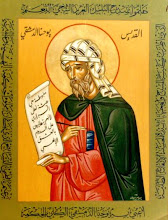
GERMANUS OF CONSTANTINOPLE: DEFENDER OF HOLY IMAGES
VATICAN CITY, 29 APR 2009 (VIS) - During his general audience this morning Benedict XVI dedicated his catechesis to St. Germanus of Constantinople, who "played an important role in the complex history of the battle for images during the so-called iconoclastic crisis, and was able to resist the pressure of an iconoclastic emperor, ... Leo III.
"During Germanus' patriarchate (715-730)", the Pope added, "the capital of the Byzantine empire, Constantinople, was subject to a threatening siege by the Saracens. On that occasion (717-718) a solemn procession was organised and passed through the streets carrying the image of the Mother of God ... and the relic of the Holy Cross to call upon the Most High to defend the city. In fact, Constantinople was freed from the siege".
This event convinced the patriarch "that God's intervention was to be interpreted as evident approval of the reverence people showed towards holy icons. Leo III on the other hand, who came to the throne in that year of 717, ... began ever more openly to show his conviction that the consolidation of empire had to begin by reorganising expressions of faith, with particular reference to idolatry, a risk to which, in his view, the people were exposed by their excessive veneration for icons".
The Holy Father went on: "Patriarch Germanus' appeals to Church tradition and to the real effectiveness of certain images, unanimously recognised as 'miraculous', were all to no avail. The emperor became ever more intractable in implementing his policies of reform. ... Germanus had no desire to bow to the emperor's will in matters he considered vital to orthodox faith. ... As a consequence he felt obliged to resign as patriarch, condemning himself to exile in a monastery where he died in obscurity. Nonetheless his name re-emerged at the Second Nicean Council ... of 787 where his merits were recognised".
Of Germanus' works "certain homilies on Marian themes have survived, of which some have had a profound influence on the piety of entire generations of faithful, both in the East and the West", including one which Pope Pius XII "set like a pearl in the 1950 Apostolic Constitution 'Munificentissimus Deus'", dedicated to the Assumption of the Virgin Mary.
Benedict XVI went on to recall the "great contribution" this saint made to the Byzantine tradition in which "the rhetorical forms used in preaching, and even more so in hymns and poetical compositions, ... are as important to the celebration of the liturgy as the beauty of the sacred building in which it takes place".
The Holy Father concluded by considering three aspects in which St. Germanus still has something to say to modern man. Firstly, in the need to recognise "the visibility of God in the world and in the Church", because "God created man in His image but that image was covered with dirt and sin" and the Creator "could almost no longer see it. Thus the Son of God became man and ... in Christ, the true image of God, we too can ... learn to see ourselves as His image". If, to prevent idolatry and the danger of pagan images, God prohibited the Israelites from creating His image, yet "when He became visible in Christ through the Incarnation it became legitimate to reproduce the face of Christ. ... Holy images teach us to see God in the face of Christ, ... of the saints and of all human beings".
Secondly, Germanus shows us "the beauty and dignity of the liturgy", which must be celebrated "with an awareness of the presence of God and with a beauty and dignity that enable us to glimpse His splendour".
The third aspect is that of "love for the Church", the Pope concluded. "It may be that in the Church, as in ourselves, we see sin and other negative things, yet with the help of faith ... we can always rediscover divine beauty in the Church. In the Church, God offers Himself to us in the Eucharist, He speaks to us, ... He forgives us and He teaches us to forgive. Let us pray that God may teach us to see His presence and His beauty in the Church, to see His presence in the world".
AC/GERMANUS/... VIS 090429 (710)
Wednesday, April 29, 2009


Tuesday, April 28, 2009
Wisdom for our day from St Ephraim the Syrian
Lament over the scarcity of saints
My heart is pained, my soul agonizes and my inner parts are torn! Where am I to find the tears, where am I to find the contrition and the sighs to rightly mourn our orphaned state and the paucity of sanctity among us?
I see, O Master, that Thou takest Thy saints, like choice gold, from the vain world to the resting-place of life.
Like a farmer who sees his fruits well ripened and prudently hastens to gather them that they might not be the least bit spoiled, so doest Thou also, O Savior, gather Thy chosen ones who have labored righteously.
Yet we, who are slothful and weak-willed, remain hardened, and our fruits never ripen; for we have not the resolve to labor without sparing ourselves, in order to ripen the good works and rightly be gathered into the storehouse of life.
Say: woe is me, alas, O soul, and weep; for thou hast been left an orphan so young by the blameless fathers and righteous ascetics. Where are our fathers? Where are the saints? Where are the vigilant? Where are the sober? Where are the humble? Where are the meek? Where are those who vow silence? Where are the abstinent? Where are those who with a contrite heart stood before the Lord in perfect prayer, like angels of God? They have left here to join our holy God with their lamps brightly burning.
Woe is us! What times are these in which we live? Into what sea of evil have we sailed? Our fathers have entered the harbor of life, that they might not see the sorrows and seductions that overcome us because of our sins. They are crowned, yet we slumber; we sleep and indulge in selfish pleasures.
O Lord, have pity on us! Make sober our thoughts which whirl about in vain. Grant us contrition and tears, that they might shed some light on the blindness of our hearts, and we might see that way in which our fathers walked when they followed Thee. Grant us the desire and the strength to follow in this same way, so that we too with them might receive the lot of those who are saved, to the glory of Thy Name.
*From A Spiritual Psalter: or Reflections on God excerpted by Bishop Theophan the Recluse from the works of our Holy Father Ephraim the Syrian.
While I would prefer to post joyous things during this Holy Season, perhaps we still need to consider our lives in the light of the urgent necessity of repentance.
Sunday, April 19, 2009
Subscribe to:
Posts (Atom)