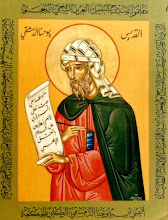
Thanks to Archpriest Michael Hayduk and Father Deacon Paul J. Leonarczyk, for the schema to read through St John of Sinai's Ladder of Divine Ascent during the Great Fast. The Ladder (from which St John received the 'nickname" Klimakos - "ladder" in Greek) was written in response to another Abbot's advice on promoting health spirituality in his monastery. St John's reply proved such a thorough and clear exposition that it has become de rigueur Lenten reading in Eastern Christians monasteries all over the world. As St John's writings are also easily accessible to the average reader, it has also become a favorite among the Byzantine Catholic and Orthodox laity as well. It is easily found in several English editions, the two most widely available being John Climacus: The Ladder of Divine Ascent (The Classics of Western Spirituality) and as The Ladder of Divine Ascent, published by Holy Transfiguration Monastery. Both are highly readable, the Holy Transfiguration Monastery edition perhaps presenting a more erudite and nuanced translation.
Below is the arrangement for those who keep the Horologion. For those unacquainted with "the Hours" Third=9:00 am; Sixth=Noon; ninth=3:00 pm (approximately). One could also easily consider a time-table dividing as "on rising", "after work" and "near bedtime"; or even combining selections of the individual daily readings as one chooses. In any event, the Ladder is, after the Scriptures and Divine Services of the Season, the par excellence choice for Lenten reading.
Showing posts with label Books. Show all posts
Showing posts with label Books. Show all posts
Wednesday, February 10, 2010


Thursday, May 29, 2008
A Book I Missed
I just came accross Relgious Information Service of Ukraine report about a book by Bishop Paul Peter Jesep of the Ukrainian Autocephalous Orthodox Church Kyiv-Patriarchate entitled, "Crucifying Jesus and Secularizing America -- The Republic of Faith without Wisdom".
If anyone is familiar with this book, please comment. I would like to know your opinions.
If anyone is familiar with this book, please comment. I would like to know your opinions.
History's Mis-teries - Mistaken Misconceptions
Hat Tip to Touchstone's Anthony Esolen for a promising "part one" on "How to Tell a Barbarian" and the sited Weekly Standard article by Charlotte Allen, "A Dark Age for Medievalists".
But a few generations ago the basic "darkness" of the middle ages was the complete absence of any knowledge about the Byzantine world. The misconception about the West was whether there really were any "dark ages" as the anti-Catholic Gibbons postulated. In our post-modern "enlightened" times, anything European, Christian, or Catholic is apparently open to any sort of opprobrium available.
For real history and objective analysis, I recommend:
How the Catholic Church Built Western Civilization by Thomas E. Woods Jr
The Victory of Reason: How Christianity Led to Freedom, Capitalism, and Western Success by Rodney Stark
Without Roots: The West, Relativism, Christianity, Islam by Joseph Cardinal Ratzinger & Marcello Pera (Previously lauded by yours truly)
Christianity and the Crisis of Cultures by Pope Benedict XVI & Marcello Pera (Also ramblingly lauded here)
and
What's So Great About Christianity by Dinesh D'Souza (This book might profitably be read in conjunction with How the Catholic Church Built Western Civilization as they are almost parallel projects in many ways.
UPDATE: Part II of the Barbarian Study is out.
Update Update: Part III of the Barbarian Study is now also out.
But a few generations ago the basic "darkness" of the middle ages was the complete absence of any knowledge about the Byzantine world. The misconception about the West was whether there really were any "dark ages" as the anti-Catholic Gibbons postulated. In our post-modern "enlightened" times, anything European, Christian, or Catholic is apparently open to any sort of opprobrium available.
For real history and objective analysis, I recommend:
How the Catholic Church Built Western Civilization by Thomas E. Woods Jr
The Victory of Reason: How Christianity Led to Freedom, Capitalism, and Western Success by Rodney Stark
Without Roots: The West, Relativism, Christianity, Islam by Joseph Cardinal Ratzinger & Marcello Pera (Previously lauded by yours truly)
Christianity and the Crisis of Cultures by Pope Benedict XVI & Marcello Pera (Also ramblingly lauded here)
and
What's So Great About Christianity by Dinesh D'Souza (This book might profitably be read in conjunction with How the Catholic Church Built Western Civilization as they are almost parallel projects in many ways.
UPDATE: Part II of the Barbarian Study is out.
Update Update: Part III of the Barbarian Study is now also out.
Thursday, May 24, 2007
Catholic World News on Atheist Contribution
Catholic World News has a short but interesting report on an atheist giving a large donation to the Archdiocese of New York.
New York, May. 24, 2007 (CWNews.com) - The New York archdiocese has received a record-breaking gift of $22.5 million from an atheist.Lest anyone think this quote from Mr Wilson is merely a compliment, I would recommend How the Catholic Church Built Western Civilization, available from Amazon.
Robert Wilson, a retired financier, has given the sum-- the largest single donation ever recorded by the Church in New York-- to a program that will pay tuition for needy children attending New York's parochial schools.
Explaining his decision to make the grant to a Catholic charity, Wilson pointed out that his money would be used to pay for the education of children, rather than for specifically religious purposes.
While he is not religious, Wilson indicated a deep respect for the Catholic faith. "Let's face it," he told a reporter: "without the Roman Catholic Church there would be no Western civilization."
Monday, April 23, 2007
Well-grounded Analysis of Society’s Ills in a Tidy Little Cover
The 2006 publication Without Roots: The West, Relativism, Christianity, Islam is the kind of book that one might choose to avoid for any of several reasons.
1) It is primarily the transcription of two speeches, the first a lecture by Professor Marcello Pera to the Lateranese Pontifical University and the other an address by then-Cardinal Ratzinger (Pope Benedict XVI) to the Italian Senate. Speeches seldom translate well to the printed page.
2) Further, the subject matter might be considered somewhat esoteric: the detrimental influence of relativism on European society, and by extension on Western Society as a whole.
3) Add to this the fact that what we have in this little book is an English translation of presentations given in Italian, one by a scholar whose native language is German, and the potential for tedium rivals a Baillie translation of Hegel.
Be encouraged, then: Without Roots is both accessible and brief. Professor Pera and then-Cardinal Ratzinger speak with the eloquent clarity of great minds who can squarely perceive the reality of a problem, identify its origins and and sketch out thought-provoking and challenging solutions. The text is clear, precise and cogent. The novice will find it easy to follow the discussion and the connoisseur of philosophical argumentation will not be disappointed.
The format of the book is simple: Professor Pera's lecture is followed by then-Cardinal Ratzinger's speech. The book concludes with an exchange of letters between the Professor and the Cardinal that highlight and further clarify their positions. Generous end notes provide context and additional information for the interested reader.
For those who are following the unfolding theology of Pope Benedict XVI, Without Roots offers a basic primer in themes emerging as central to his teachings. The contrast between Pera’s views and those of the future Pope, illuminated by their juxtaposition in the book, allows the reader a better understanding of the underlying topic as a whole, as well as the differing approaches each of the two men follow in addressing the issue and the distinct solutions each offers.
Below are several snippets to whet your appetite.
Pera: The thinking that currently prevails in the West regarding the universal features of the West is that none of them has universal value. According to the proponents of these ideas, the universality of Western institutions is an illusion, because in reality they are only one particularity among many, with a dignity equal to that of others, and without any intrinsic value superior to that of others. (p 3)
Pera: My own explanation is that in the age of triumphant relativism and “silent apostasy,” belief in the true no longer exists: the mission of the true is considered fundamentalism and the very affirmation of the true creates or raises fears. (p 37)
Ratzinger: Europe is infected by a strange lack of desire for the future. Children, our future, are perceived as a threat to the present, as if they were taking something away from our lives. Children are seen as a liability rather than as a source of hope. There is a clear comparison between today’s situation and the decline of the Roman Empire. (p 66)
Ratzinger: …the more relativism becomes the generally accepted way of thinking, the more it tends toward intolerance, thereby becoming a new dogmatism. Political correctness… seeks to establish the domain of a single way of thinking and speaking. Its relativism creates the illusion that it has reached greater heights than the loftiest philosophical achievements of the past. It prescribes itself as the only way to think and speak – if, that is, one wishes to stay in fashion. Being faithful to traditional values and to the knowledge that upholds them is labeled intolerance, and relativism becomes the required norm. I think it is vital that we oppose this imposition of a new pseudo-enlightenment, which threatens freedom of thought as well as freedom of religion.(p 128)
This is a great little book and well worth an afternoon of your time. Pick it up via either Amazon.com or the Daughters of St Paul.
1) It is primarily the transcription of two speeches, the first a lecture by Professor Marcello Pera to the Lateranese Pontifical University and the other an address by then-Cardinal Ratzinger (Pope Benedict XVI) to the Italian Senate. Speeches seldom translate well to the printed page.
2) Further, the subject matter might be considered somewhat esoteric: the detrimental influence of relativism on European society, and by extension on Western Society as a whole.
3) Add to this the fact that what we have in this little book is an English translation of presentations given in Italian, one by a scholar whose native language is German, and the potential for tedium rivals a Baillie translation of Hegel.
Be encouraged, then: Without Roots is both accessible and brief. Professor Pera and then-Cardinal Ratzinger speak with the eloquent clarity of great minds who can squarely perceive the reality of a problem, identify its origins and and sketch out thought-provoking and challenging solutions. The text is clear, precise and cogent. The novice will find it easy to follow the discussion and the connoisseur of philosophical argumentation will not be disappointed.
The format of the book is simple: Professor Pera's lecture is followed by then-Cardinal Ratzinger's speech. The book concludes with an exchange of letters between the Professor and the Cardinal that highlight and further clarify their positions. Generous end notes provide context and additional information for the interested reader.
For those who are following the unfolding theology of Pope Benedict XVI, Without Roots offers a basic primer in themes emerging as central to his teachings. The contrast between Pera’s views and those of the future Pope, illuminated by their juxtaposition in the book, allows the reader a better understanding of the underlying topic as a whole, as well as the differing approaches each of the two men follow in addressing the issue and the distinct solutions each offers.
Below are several snippets to whet your appetite.
Pera: The thinking that currently prevails in the West regarding the universal features of the West is that none of them has universal value. According to the proponents of these ideas, the universality of Western institutions is an illusion, because in reality they are only one particularity among many, with a dignity equal to that of others, and without any intrinsic value superior to that of others. (p 3)
Pera: My own explanation is that in the age of triumphant relativism and “silent apostasy,” belief in the true no longer exists: the mission of the true is considered fundamentalism and the very affirmation of the true creates or raises fears. (p 37)
Ratzinger: Europe is infected by a strange lack of desire for the future. Children, our future, are perceived as a threat to the present, as if they were taking something away from our lives. Children are seen as a liability rather than as a source of hope. There is a clear comparison between today’s situation and the decline of the Roman Empire. (p 66)
Ratzinger: …the more relativism becomes the generally accepted way of thinking, the more it tends toward intolerance, thereby becoming a new dogmatism. Political correctness… seeks to establish the domain of a single way of thinking and speaking. Its relativism creates the illusion that it has reached greater heights than the loftiest philosophical achievements of the past. It prescribes itself as the only way to think and speak – if, that is, one wishes to stay in fashion. Being faithful to traditional values and to the knowledge that upholds them is labeled intolerance, and relativism becomes the required norm. I think it is vital that we oppose this imposition of a new pseudo-enlightenment, which threatens freedom of thought as well as freedom of religion.(p 128)
This is a great little book and well worth an afternoon of your time. Pick it up via either Amazon.com or the Daughters of St Paul.
Monday, February 26, 2007
The Texts -- Where To Get Them
It strikes me that some of you might wish to know from where the texts in the "From the Triodion" posts are taken.
The Melkite Greek Catholic Eparchy of Netwon has translated and published nearly the entire collection of liturgical "hymn books" of the Byzantine Tradition. The excerpts in these posts are taken from the three volume set, The Triodion, published by Sophia Press.
The books are excellently printed in spiral-bound format with a "chanter's size" font on good-quality paper. The costs are moderate, and I highly recommend them for anyone wishing to deepen their appreciation of the Byzantine Tradition, especially during Great Lent.
The Melkite Greek Catholic Eparchy of Netwon has translated and published nearly the entire collection of liturgical "hymn books" of the Byzantine Tradition. The excerpts in these posts are taken from the three volume set, The Triodion, published by Sophia Press.
The books are excellently printed in spiral-bound format with a "chanter's size" font on good-quality paper. The costs are moderate, and I highly recommend them for anyone wishing to deepen their appreciation of the Byzantine Tradition, especially during Great Lent.
Subscribe to:
Posts (Atom)