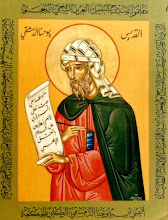
The Patriarch of Antioch, His Beatitude Gregory III, has issued his Letter for the Feast of the Nativity for 2007. To read it, click here.
You might enjoy checking out some of his other allocutions.
Thursday, December 20, 2007


A few interesting articles...
Below are links to a few interesting articles worth reading and pondering.
From MercatorNet, an article on unwed mothers.
From the same source, an article on the myth of the teenage brain.
First Things' On the Square has a nice piece on Icons.
Chiesa features a review of the recent Vatican document on Evangelisation.
Interfax has a few interesting articles here, and here, and here, and here, and finally here revealing the mind of the Russian Orthodox Church.
From the International Herald Tribune the news that Israel has finally given official recognition to the Greek Orthodox Patriarch of Jerusalem.
And finally, the Catholic News Agency reports on the continued exodus for Christians from the holy lands.
From MercatorNet, an article on unwed mothers.
From the same source, an article on the myth of the teenage brain.
First Things' On the Square has a nice piece on Icons.
Chiesa features a review of the recent Vatican document on Evangelisation.
Interfax has a few interesting articles here, and here, and here, and here, and finally here revealing the mind of the Russian Orthodox Church.
From the International Herald Tribune the news that Israel has finally given official recognition to the Greek Orthodox Patriarch of Jerusalem.
And finally, the Catholic News Agency reports on the continued exodus for Christians from the holy lands.
Wednesday, December 19, 2007
The Birth of Christ - Hope and Contradiction
The Holy Father's talk at the general audience today touched on the Mystery of the Incarnation. The unity of the Pope's thought and theology is breathtaking. (I've pondered recently that while John Paul the Great was Pope for a very long time, even accounting for that, his literary theological output was voluminous and complex. Benedict, on the other hand, while only Pope for a brief time thus far has revealed a genius for compact, clear and challenging theological reflection. Witness the immediately accessible Deus Caritas Est and Spe Salvi in comparison to any one of John Paul's Encyclicals.)
The Vatican Information Service has released a summary of his talk. One can hardly wait for the whole text! Below are a couple of excerpts.
UPDATE: Zenit now has the full text online.
The Vatican Information Service has released a summary of his talk. One can hardly wait for the whole text! Below are a couple of excerpts.
"Hoping for justice in the Christian sense means ... that we too begin to live under the eyes of the Judge, ... creating justice in our own lives. ... In this way we can open the world to the coming of the Son and prepare our hearts to welcome the Lord Who comes."
..."Moreover," he added, "we have formed a view of tolerance and pluralism such that to believe that Truth has been effectively manifested appears to constitute an attack on tolerance and the freedom of man. If, however, truth is cancelled, is man not a being deprived of meaning? Do we not force ourselves and the world into a meaningless relativism?"
He continued: "How important it is, then, for us to reinforce the mystery of salvation which the celebration of Christ's Nativity brings. In Bethlehem the Light that illuminates our lives was revealed to the world; we were shown the Way that leads us to the fullness of our humanity. If we do not recognize that God was made man, what sense does it have to celebrate Christmas? We Christians must reaffirm with profound and heartfelt conviction the truth of Christ's nativity, in order to bear witness before everyone of the unique gift which brings wealth not just to us, but to everyone. "
..."In these days leading up to Christmas," said Pope Benedict, "the Church prays more intensely for the realization of hopes of peace and salvation, of which the world today still has such urgent need. Let us ask God for violence to be defeated with the strength of love, for contrasts to give way to reconciliation, for the desire to dominate to be transformed into a desire for forgiveness, justice and peace. May the wishes for goodness and love that we exchange over these days reach all areas of our daily lives."
UPDATE: Zenit now has the full text online.
Monday, December 17, 2007
Strangers in their own lands
Over at De unione ecclesiarum, Peter Gilbert references an article in the British journal the Tablet on Greek Catholicism and some of the troubles Greek Catholics face. The article, by Marcus Tanner, is entitled "Outsiders in their own land". (Note that the link to the article often leads to a "log-in to read page" but occasionally takes you straight to the article. Hence, reading it from Peter Gilbert's blog may be the easier path.)
Presented here are a few excerpts (and, Lord, forgive me, a couple of my comments):
...
...
May our Lord bring unity to His Church and unite all Catholic and Orthodox Christians with peace, health, safety and length of days. May our Lady the Theotokos through her intercessions convict the hearts of all of us in the Churches of God whose hardness prevents that unity for which our Lord prayed. May the confidence of hope remove all prejudice, the fruits of love melt all animosity, and the Faith that saves bless us all with eternal life to the glory of God the Father and the Son and the Holy Spirit, now and always and unto ages of ages. Amen.
Presented here are a few excerpts (and, Lord, forgive me, a couple of my comments):
“It’s difficult to understand if you’re not from here,” the archbishop says, pointing to the nearby tower of the ruined Augustinian abbey, where Mass was first said in the fourteenth century. “We are here in Greece, we feel Greek, are Greek, but among other Greeks there is this strong identification of Greek and Orthodox. As a result, when I take part in official ceremonies, they say ‘He’s not a bishop! He is not Orthodox.’”I have experienced this on many occasions in the US. For example, recently my wife and I met an OCA priest and his wife. We chatted briefly and went our separate ways. Later, Khourieh noted that the priest held out his hand in the manner traditional to receive a reverential kiss. She obliged as this is a custom she routinely practices with clergy (except yours truly....). She asked me if Matushka had kissed mine. No; I hadn't thought about it at the time, but she had not. Then, looking back on the conversation, I realized there had been a slight familiarity. Also, when I had approached Batushka for the embrace of peace he had stuck out his hand for a handshake. Clearly, to them I was not a priest and we were to show respect to them with no reciprocation. C'est la vie! It's a small thing, but indicative of how we "Uniates" are often treated by our separated brethren.
...
As the Athens-based journalist Helena Smith wrote some years ago, many Greeks “still relate to the notorious declaration of the Byzantine commander Loukas Notaras (uttered days before the sacking of Constantinople in 1453) that it would be better to see the Turkish turban in the city than a cardinal’s mitre”. That mood, stiffened by the religious dimension to the Balkan wars of the 1990s, has hardly softened at all. Smith told me: “This is still a country that is very ethnocentric, where minorities are seen as a threat to the state and where to be 100 per cent Greek you must be Orthodox.”This is endemic to Orthodoxy. While there is much talk about the Unity of the Faith, there is a tendency for many to see their jurisdiction, and the ethnicity that grounds it, as the superior others within Orthodoxy and even more so regarding Catholics in general, and Eastern Catholic in particular.
...
Back in his office, the archbishop concurred. “We have got to become really Catholic, meaning universal,” he said. “We were never really considered true Greeks anyway. Now we have to be brothers to all those coming from outside. It is the future of the Church - no Greek, no Jew, but all one in Christ. That could be something to be proud of.”This is precisely why I crossed the Tiber. There is a fullness of Catholic Faith within the Catholic Church. By this, I mean that "the Faith of the Orthodox" (as the Synodikon of Nicaea II refers to it) only attainable in union with Rome. My faith, worship, and discipline are the same as when I was an Orthodox priest, but the fullness of that Faith is more profoundly present through communion with the Pope of Rome. This may scandalize Orthodox, and in fact probably lies much behind the manifest desire of Orthodox for Eastern Catholics to cease to exist.
May our Lord bring unity to His Church and unite all Catholic and Orthodox Christians with peace, health, safety and length of days. May our Lady the Theotokos through her intercessions convict the hearts of all of us in the Churches of God whose hardness prevents that unity for which our Lord prayed. May the confidence of hope remove all prejudice, the fruits of love melt all animosity, and the Faith that saves bless us all with eternal life to the glory of God the Father and the Son and the Holy Spirit, now and always and unto ages of ages. Amen.
Sunday, December 16, 2007
Hymns and Readings for Sunday
16 DECEMBER 2007
SUNDAY OF THE FOREFATHERS OF CHRIST
TWENTY-EIGHTH SUNDAY OF PENTECOST)
Commemorating the holy Prophet Haggai
Tone Four — Eothinon Seven
TROPARIA AND KONTAKION
(theme hymns of the day and concluding seasonal hymn)
TROPARION OF THE RESURRECTION IN TONE FOUR
The women disciples of the Lord having heard from the angel the joyful announcement of the Resurrection, and having rejected the ancestral sentence, proudly told the Apostles: Death is despoiled, Christ God is risen, bestowing to the world great mercy.
TROPARION OF THE FOREFATHERS IN TONE TWO
Through faith, You have justified your ancestors, O Christ our God, and through them You have espoused in advance the Church set apart from the gentiles. The saints rejoice in glory because from the seed of these ancestors has come forth the glorious fruit who gave You birth without seed. Through their intercession, O Christ God, save our souls!
KONTAKION OF PREPARATION FOR THE NATIVITY OF CHRIST IN TONE THREE
Today the Virgin is on her way to the cave where she will give birth to the Eternal Word of God in an ineffable manner. Rejoice therefore, O Universe, when you hear this news, and glorify with the angels and the shepherds Him who shall appear as new Child being God from all eternity.
LITURGY OF THE WORD
PROKIMENON
(RESPONSORY FROM THE PSALTER)
Blessed art thou, O Lord, God of our fathers, and worthy of praise;
and thy name is glorified for ever.
Blessed is he whose transgression is forgiven, whose sin is covered.
THE READING FROM THE EPISTLE OF ST PAUL TO THE COLOSIANS
BRETHREN: When Christ who is our life appears, then you also will appear with Him in glory. Put to death therefore what is earthly in you: fornication, impurity, passion, evil desire, and covetousness, which is idolatry. On account of these the wrath of God is coming. In these you once walked, when you lived in them. But now put them all away: anger, wrath, malice, slander, and foul talk from your mouth. Do not lie to one another, seeing that you have put off the old nature with its practices and have put on the New Nature, which is being renewed in knowledge after the Image of its Creator. Here there cannot be Greek and Jew, circumcised and uncircumcised, barbarian, Scyth'ian, slave, free man, but Christ is all, and in all.
ALLELUIA
Moses and Aaron were among his priests,
Samuel also was among those who called on his name.
They cried to the LORD, and he answered them.
When the righteous cry for help, the LORD hears,
and delivers them out of all their troubles.
THE READING FROM THE HOLY GOSPEL ACCORDING TO ST LUKE
THE LORD SPOKE THIS PARABLE: A man once gave a great banquet, and invited many; and at the time for the banquet he sent his servant to say to those who had been invited, ‘Come; for all is now ready.’ But they all alike began to make excuses. The first said to him, ‘I have bought a field, and I must go out and see it; I pray you, have me excused.’ And another said, ‘I have bought five yoke of oxen, and I go to examine them; I pray you, have me excused.’ And another said, ‘I have married a wife, and therefore I cannot come.’ So the servant came and reported this to his master. Then the householder in anger said to his servant, ‘Go out quickly to the streets and lanes of the city, and bring in the poor and maimed and blind and lame.’ And the servant said, ‘Sir, what you commanded has been done, and still there is room.’ And the master said to the servant, ‘Go out to the highways and hedges, and compel people to come in, that my house may be filled. For I tell you, none of those men who were invited shall taste my banquet.’
HIRMOS IN TONE SIX
(a “Megalynarion” [Hymn to the Virgin] sung after the Consecration)
It is truly meet to bless you, O Theotokos, who are ever-blessed and all-blameless and the Mother of our God; more honored than the Cherubim and more glorious beyond compare than the Seraphim: you who without stain did bear God the Word, you are truly Theotokos: we magnify you.
COMMUNION HYMN
Praise the LORD!
Praise the LORD from the heavens,
Praise Him in the heights! Alleluia.
SUNDAY OF THE FOREFATHERS OF CHRIST
TWENTY-EIGHTH SUNDAY OF PENTECOST)
Commemorating the holy Prophet Haggai
Tone Four — Eothinon Seven
TROPARIA AND KONTAKION
(theme hymns of the day and concluding seasonal hymn)
TROPARION OF THE RESURRECTION IN TONE FOUR
The women disciples of the Lord having heard from the angel the joyful announcement of the Resurrection, and having rejected the ancestral sentence, proudly told the Apostles: Death is despoiled, Christ God is risen, bestowing to the world great mercy.
TROPARION OF THE FOREFATHERS IN TONE TWO
Through faith, You have justified your ancestors, O Christ our God, and through them You have espoused in advance the Church set apart from the gentiles. The saints rejoice in glory because from the seed of these ancestors has come forth the glorious fruit who gave You birth without seed. Through their intercession, O Christ God, save our souls!
KONTAKION OF PREPARATION FOR THE NATIVITY OF CHRIST IN TONE THREE
Today the Virgin is on her way to the cave where she will give birth to the Eternal Word of God in an ineffable manner. Rejoice therefore, O Universe, when you hear this news, and glorify with the angels and the shepherds Him who shall appear as new Child being God from all eternity.
LITURGY OF THE WORD
PROKIMENON
(RESPONSORY FROM THE PSALTER)
Blessed art thou, O Lord, God of our fathers, and worthy of praise;
and thy name is glorified for ever.
Blessed is he whose transgression is forgiven, whose sin is covered.
THE READING FROM THE EPISTLE OF ST PAUL TO THE COLOSIANS
BRETHREN: When Christ who is our life appears, then you also will appear with Him in glory. Put to death therefore what is earthly in you: fornication, impurity, passion, evil desire, and covetousness, which is idolatry. On account of these the wrath of God is coming. In these you once walked, when you lived in them. But now put them all away: anger, wrath, malice, slander, and foul talk from your mouth. Do not lie to one another, seeing that you have put off the old nature with its practices and have put on the New Nature, which is being renewed in knowledge after the Image of its Creator. Here there cannot be Greek and Jew, circumcised and uncircumcised, barbarian, Scyth'ian, slave, free man, but Christ is all, and in all.
ALLELUIA
Moses and Aaron were among his priests,
Samuel also was among those who called on his name.
They cried to the LORD, and he answered them.
When the righteous cry for help, the LORD hears,
and delivers them out of all their troubles.
THE READING FROM THE HOLY GOSPEL ACCORDING TO ST LUKE
THE LORD SPOKE THIS PARABLE: A man once gave a great banquet, and invited many; and at the time for the banquet he sent his servant to say to those who had been invited, ‘Come; for all is now ready.’ But they all alike began to make excuses. The first said to him, ‘I have bought a field, and I must go out and see it; I pray you, have me excused.’ And another said, ‘I have bought five yoke of oxen, and I go to examine them; I pray you, have me excused.’ And another said, ‘I have married a wife, and therefore I cannot come.’ So the servant came and reported this to his master. Then the householder in anger said to his servant, ‘Go out quickly to the streets and lanes of the city, and bring in the poor and maimed and blind and lame.’ And the servant said, ‘Sir, what you commanded has been done, and still there is room.’ And the master said to the servant, ‘Go out to the highways and hedges, and compel people to come in, that my house may be filled. For I tell you, none of those men who were invited shall taste my banquet.’
HIRMOS IN TONE SIX
(a “Megalynarion” [Hymn to the Virgin] sung after the Consecration)
It is truly meet to bless you, O Theotokos, who are ever-blessed and all-blameless and the Mother of our God; more honored than the Cherubim and more glorious beyond compare than the Seraphim: you who without stain did bear God the Word, you are truly Theotokos: we magnify you.
COMMUNION HYMN
Praise the LORD!
Praise the LORD from the heavens,
Praise Him in the heights! Alleluia.
Saturday, December 15, 2007
Book Review by Cardinal Ruini
Camillo Cardinal Ruini addressed the Roman Clergy recently and, amongst other things, presented a powerful review and analysis of Pope Benedict's book Jesus of Nazareth. Sandro Magister reports on the talk and includes the text of the section dealing with the Holy Father's Christological masterpiece. Below are a few excerpts.
Incidentally, I recently bought the book on disc and have been listening during the twice daily frustration of driving -- it is truly making the "rush" hour parking experience more fruitful!
One question that Ruini examines is the political question. What sort of social and political structure might be derived from such a seemingly apolitical lesson of Jesus as the Sermon on the Mount?Click over to Chiesa and read the Cardinal's whole analysis. Then, click over to Ignatius Press or Amazon and order the book. A better Christmas present for the soul and mind will be hard to find.
Ruini's answer – in the light of the book by Benedict XVI – is that Jesus has freed political and social structures from any pretense of sacredness and of "divine right," entrusting them instead to human freedom.
...
In reality, it is only by beginning with God that one can understand man, and it is only when man lives in relationship with God that his life becomes authentic: this is the meaning of the Sermon on the Mount, which delineates, in its overturning of false values, a complete picture of authentic humanity.
...
With the parable of the good Samaritan, however, Jesus shows us that there is no question of establishing who is or is not my neighbor: the question concerns me, I must become neighbor, so that the other - anyone else, universally - matters as much to me as I do. The relevance of the parable is obvious. If we apply it to the dimensions of globalized society, the robbed and plundered populations of Africa – and not only of Africa – concern us intimately, and demand our attention from a twofold point of view: because through the events of our history, through our lifestyle, we have contributed and still contribute to despoiling them, and because, instead of giving them God, the God who is close to us in Jesus Christ, we have brought the cynicism of a world without God.
Incidentally, I recently bought the book on disc and have been listening during the twice daily frustration of driving -- it is truly making the "rush" hour parking experience more fruitful!
Tuesday, December 11, 2007
Several Interesting Articles
Joseph Bottum in today's On the Square characterizes Robert P. George's Law and Moral Purpose in the current First Things as a tour de force. This is an understatement. Take my advise, read, learn and inwardly digest (as the Anglican's used to say).
Over at MercatorNet, Thomas Lickona writes on Character-based Sex Education in a very thought provoking article. And while you're visiting MercatorNet, you might also want to read Carolyn Moynihan's Focus on sex education: eyes on Manila from back in November.
And finally, Sandro Magister, over at Chisea, writes on the School of Bologna's attempt to co opt Pope Benedict's indictment of the hermeneutics of discontinuity as actually supporting their views on the Second Vatican Council. Fascinating...
Over at MercatorNet, Thomas Lickona writes on Character-based Sex Education in a very thought provoking article. And while you're visiting MercatorNet, you might also want to read Carolyn Moynihan's Focus on sex education: eyes on Manila from back in November.
And finally, Sandro Magister, over at Chisea, writes on the School of Bologna's attempt to co opt Pope Benedict's indictment of the hermeneutics of discontinuity as actually supporting their views on the Second Vatican Council. Fascinating...
Subscribe to:
Posts (Atom)