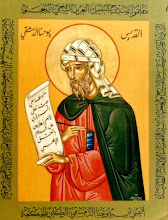
The work of the priesthood is done on earth, but it is ranked among heavenly ordinances. And this is only right, for no man, no angel, no archangel, no other created power, but the Paraclete Himself ordained this succession, and persuaded men, while still remaining in the flesh to represent the ministry of angels. The priest, therefore, must be pure as is he were standing in heaven itself, in the midst of those powers.
St John Chrysostom, Six Books On the Priesthood, St Vladimir's Seminary Press, New York, 1996, page 70
Were to the Lord that I obtained even to a miniscule level of othe perfection and purity of which the Golden-tounged speaks. Please pray for you unworthy servant.
Showing posts with label humility. Show all posts
Showing posts with label humility. Show all posts
Friday, April 16, 2010


Thursday, April 15, 2010
The Fear of God according to Elder Thaddeus
The fear of God is not the animal-like fear of this world. Our fear is like that, and we must strive to conquer this. Such fear is from Hades. Our life is filled with fear. We fear what tomorrow will bring, what he future has in store for us.... That is an animal-like fear. The fear of God is when you love Him, when you truly love Him with all your heart and your strive never to offend or sadden Him - not only with your deeds, actions, and words, but also with your thoughts. You try to please Him in everything you do or say. That is the fear of God - the fear of doing anything that might saddened or offend our Parent.
Our Thoughts Determine our Lives: The Life and Teachings of Elder Thaddeus of Vitovnica, Translated by Anna Smiljanic, Saint Herman of Alaska Brotherhood, Platina, CA, 2009, p. 97f.
Our Thoughts Determine our Lives: The Life and Teachings of Elder Thaddeus of Vitovnica, Translated by Anna Smiljanic, Saint Herman of Alaska Brotherhood, Platina, CA, 2009, p. 97f.
Friday, April 09, 2010
Always Good (and Godly) Advice
Never confuse the person, formed in the image of God, with the evil that is in him: because evil is but a chance misfortune, an illness, a devilish attack. But the very essence of the person is the image of God, and this remains in him despite every disfigurement.
St. John of Kronstadt
St. John of Kronstadt
Elder Joseph the Hesychast on Negligence
Christ is risen! Truly, He is risen!
Salt of the Earth's Andrew always digs deep finding rich treasures of spiritual insight. His is one of my daily stops during my "blog review" period.
For Wednesday of this week which, of course, was Wednesday of Bright Week, and for Traditional Orthodox also the Feast of the Annunciation, Andrew offered a most beautifully and timely quote from the blessed Elder Joseph the Hesychast on the topic of negligence.
Blessed Elder Joseph was a giant of the twentieth century revival in Athonite Spirituality. The sanctity of his personhood not only deeply affected those who have read his writings, but profoundly touched those privileged to know him personally such that one can see it when encountering them.
Below is the quote Andrew has from the Elder:
For everyone celebrating Bright Week it also reminds us that we, too, live life fully only when we find the fullness of our personhood in the Risen Lord. Self-esteem is always harmful in that it is founded on a false appraisal of our worth. Only righteous humility in the Divine Light of Christ's great mercy allows us to truly see ourselves as we are. Only humble obedience frees us from slavery to an impoverished and corrupt life that already reeks of death. In the light of the Resurrection we discover true life, self-worth, and eternal joy.
Read over again the Blessed Elder's insight and let it sink in. If we are all lucky, it will sink into the hearts of each of us bringing us closer to the Most Holy Trinity and the image and likeness we were created to possess.
Salt of the Earth's Andrew always digs deep finding rich treasures of spiritual insight. His is one of my daily stops during my "blog review" period.
For Wednesday of this week which, of course, was Wednesday of Bright Week, and for Traditional Orthodox also the Feast of the Annunciation, Andrew offered a most beautifully and timely quote from the blessed Elder Joseph the Hesychast on the topic of negligence.
Blessed Elder Joseph was a giant of the twentieth century revival in Athonite Spirituality. The sanctity of his personhood not only deeply affected those who have read his writings, but profoundly touched those privileged to know him personally such that one can see it when encountering them.
Below is the quote Andrew has from the Elder:
Self-esteem corrupts treasures that have been amassed, while negligence does not even let you collect them. Negligence is like a drought in which nothing grows. Self-esteem damages those that have fruit, who have made some progress; whereas negligence harms everyone, because it impedes those who want to make a start, it stops those who have advanced, it does not allow the ignorant to learn, it prevents those who have gone astray from returning, it does not permit the fallen to get up – in general, negligence spells destruction for all those it holds captive.For the Traditional Orthodox celebrating the Annunciation, this quote is timely in that it highlights by contrast the holiness of the Theotokos who lived her life in humility and obedience to the Lord, exercising her will in synergy with the Incarnation.
* This excerpt is from “Elder Joseph the Hesychast: Struggles, Experiences, Teachings” by Elder Joseph of Vatopedi
For everyone celebrating Bright Week it also reminds us that we, too, live life fully only when we find the fullness of our personhood in the Risen Lord. Self-esteem is always harmful in that it is founded on a false appraisal of our worth. Only righteous humility in the Divine Light of Christ's great mercy allows us to truly see ourselves as we are. Only humble obedience frees us from slavery to an impoverished and corrupt life that already reeks of death. In the light of the Resurrection we discover true life, self-worth, and eternal joy.
Read over again the Blessed Elder's insight and let it sink in. If we are all lucky, it will sink into the hearts of each of us bringing us closer to the Most Holy Trinity and the image and likeness we were created to possess.
Tuesday, March 30, 2010
The Syrian and the Serbian
Make peace with yourself, and both heaven and earth will make peace with you.
St Isaac the Syrian.
All the Holy Fathers lived a good life, a quiet life. All of hem say that the perfection of the Christian life is in extreme humility. This means that patient long-suffering is what we most need in this life. We must bear everything patiently and forgive all. If we have good thoughts and desires, these thoughts will give us peace and joy even in this life, and even more so in eternity. Then we will see that there no death, that the Lord has vanquished death, and that He has given us eternal life!
Elder Thaddeus of Vitovnica
St Isaac the Syrian.
All the Holy Fathers lived a good life, a quiet life. All of hem say that the perfection of the Christian life is in extreme humility. This means that patient long-suffering is what we most need in this life. We must bear everything patiently and forgive all. If we have good thoughts and desires, these thoughts will give us peace and joy even in this life, and even more so in eternity. Then we will see that there no death, that the Lord has vanquished death, and that He has given us eternal life!
Elder Thaddeus of Vitovnica
Saturday, March 20, 2010
From the Evergetinos
An Elder said: Humility has often saved many, even without effort; this is demonstrated by the Publican and the Prodigal Son, who said only a few words and were saved.
Abba Isaiah said: "We need humility more than any other virtue; let us always be ready, whatever word we might say or hear, or whatever we might do, to say 'forgive me'; for through humility, all of the evil works of the Devil are foiled."
Evergetinos (I.XLIV.8,10)
Abba Isaiah said: "We need humility more than any other virtue; let us always be ready, whatever word we might say or hear, or whatever we might do, to say 'forgive me'; for through humility, all of the evil works of the Devil are foiled."
Evergetinos (I.XLIV.8,10)
Sunday, January 03, 2010
Wisdom from the Desert
Abba Agathon said, “I consider no other labor as difficult as prayer. When we are ready to pray, our spiritual enemies interfere. They understand it is only by making it difficult for us to pray that they can harm us. Other things will meet with success if we keep at it, but laboring at prayer is a war that will continue until we die.”
It was said concerning Abba Agathon that some monks came to find him, having heard tell of his great discernment. Wanting to see if he would lose his temper, they said to him, “Aren’t you that Agathon who is said to be a fornicator and a proud man?” “Yes, it is very true,” he answered. They resumed, “Aren’t you that Agathon who is always talking nonsense?” “I am.” Again they said, “Aren’t you Agathon the heretic?” But at that, he replied, “I am not a heretic.” So they asked him, “Tell us why you accepted everything we cast against you, but repudiated this last insult.” He replied, “The first accusations I take to myself, for that is good for my soul. But heresy is separation from God. Now I have no wish to be separated from God.” At this saying they were astonished at his discernment and returned, edified.
(The Sayings of the Desert Fathers: The Alphabetic Collection.
It was said concerning Abba Agathon that some monks came to find him, having heard tell of his great discernment. Wanting to see if he would lose his temper, they said to him, “Aren’t you that Agathon who is said to be a fornicator and a proud man?” “Yes, it is very true,” he answered. They resumed, “Aren’t you that Agathon who is always talking nonsense?” “I am.” Again they said, “Aren’t you Agathon the heretic?” But at that, he replied, “I am not a heretic.” So they asked him, “Tell us why you accepted everything we cast against you, but repudiated this last insult.” He replied, “The first accusations I take to myself, for that is good for my soul. But heresy is separation from God. Now I have no wish to be separated from God.” At this saying they were astonished at his discernment and returned, edified.
(The Sayings of the Desert Fathers: The Alphabetic Collection.
Tuesday, November 24, 2009
Wisdom from the Desert and the Fathers
He who asks to receive his daily bread does not automatically receive it in its fullness as it is in itself: he receives it according to his own capacity as recipient.
St. Maximos the Confessor
…alas for the soul that is unaware of its wounds and that in its endless sinfulness and obduracy does not think it has anything evil within it: the good doctor will not visit it or heal it, since it does not seek Him out or have any concern for its wounds, because it thinks it is well and in good health. As the Lord said: 'It is not the healthy that need a doctor, but the sick' (Mt. 9:12).
St. Makarios of Egypt
…if you are not what you should be, you should not despair. It is bad enough that you have sinned; why in addition do you wrong God by regarding Him in your ignorance as powerless? Is He, Who for your sake created the great universe that you behold, incapable of saving your soul? And if you say that this fact, as well as His incarnation, only makes your condemnation worse, then repent; and He will receive your repentance...
St. Peter of Damaskos
With regard to patience the Lord says, 'You will gain possession of your souls through your patient endurance' (Luke 21:19). He did not say 'through your fasting' or 'through your vigils'. I refer to the patience bestowed by God, which is the queen of virtues, the foundation of courageous actions. It is patience that is peace amid strife, serenity amid distress, and a steadfast base for those who acquire it. Once you have attained it with the help of Christ Jesus, no swords and spears, no attacking armies, not even the ranks of demons, the dark phalanx of hostile powers, will be able to do you any harm.
St. Gregory of Sinai
…from the instant we are baptized, grace is hidden in the depths of the intellect, concealing its presence even from the perception of the intellect itself. When someone begins, however, to love God with full resolve, then in a mysterious way, by means of intellectual perception, grace communicates something of its riches to the soul. Then, if he really wants to hold fast to this discovery, he joyfully starts longing to be rid of all his temporal goods, so as to acquire the field in which he has found the hidden treasure of life (cf. Mt. 13:44). This is because, when someone rids himself of all worldly riches, he discovers the place where the grace of God is hidden. For as the soul advances, divine grace more and more reveals itself to the intellect.
St. Diadochos of Photiki
For Holy Communion, the confession of our sins to a father confessor is needed; whereas for our communication with God, the confession of our weaknesses before Him is necessary. When we pray with pain for our fellow men, then our kind God abundantly gives us His grace. When someone celebrates his name day, wish him thus: May you live many years which will be pleasing to God.
Elder Paisios of the Holy Mountain
Thursday, September 17, 2009
A Contemporary Father on Humility
HEART BEAT, Yudhie Indonesia's Blog (in English) is the very nice blog of a young Orthodox Christian from (you guessed it) Indonesia. His perspectives are quite engaging. His choice of quotations reflecting the Eastern Christian phronema are also quite good. Here, he quotes from Father Paisius (Olaru) of Sihla Skete, Romania.
Beautiful saying of Father Paisius (Olaru) of Sihla Skete, Romania "What is humility, Father Paisius?" some of his disciples once asked him.
Fr. Paisius: "Humility is the thought and conviction of our heart that we are more sinful than all men and unworthy of the mercy of God. Reviling ourselves does not mean that we have true humility. True humility is when someone shames and abuses us publicly, and we endure it and say, "God ordered that brother to shame me for my many sins." We should receive everything as a command from God. When someone shames you, say that God commanded him to do it. When someone takes something of yours, God commanded him to take it, in order to make you a monk. When you are removed from a higher place, God changed your place so that you would change from your passions and bad habits. This is true humility. And the pride is when we trust in ourselves, in our mind, our strength, when we think we are more capable than someone else, better, more beautiful, more virtuous, more pleasing to God. Then it is certain that we are overcome by the ugly sin of pride, from which may God, who humbled Himself for our salvation, preserve us. Let us humble ourselves, brethren, because a proud man cannot be saved. Let us weep for our sins here, so we can rejoice forever in the next life, for after we leave this world everyone will forget us. Let us not hope in men, but only in God..." (From The Orthodox Word, Vol 28, No 1 (#162 --Jan-Feb, 1992)
Friday, September 11, 2009
Words of Wisdom from the Church Fathers
On Living Simply
XLIV
St. John Chrysostom
Note to self: Find a copy of Patriarch John's book and study it. Then pray it and study it again!
XLIV
St. John Chrysostom
"How should the Church be governed? Should the patriarchs act like emperors, issuing decrees which all believers must obey? Should bishops see themselves as local governors, demanding unquestioning submission of the people? Should the clergy be a kind of spiritual army, enforcing the will of the patriarchs and the bishops, and meting out punishment on sinners? The first consideration for the Church is not how to punish sins, but how to prevent sins from being committed... Moreover, each individual is answerable not to a priest, bishop or patriarch, but to God. So the primary authority of those within the Church is not to issue decrees, but to stir up the souls and enliven the consciences of believers... In short those in authority within the Church should see themselves not as rulers, but but as preachers and pastors."I discovered the above quote on another website and found it such a beautiful and inspirational statement that I had to cop it for inclusion here. I account myself most blessed to serve in a Church whose superiors are exemplary of the kind of clergy the good Patriarch John endorses. For those of you who read or follow this rambling blog, please pray for me that I may grow in humility, obedience, and tenderness as a pastor and preacher. May I ever grow more deeply in love with the Gospel that is life and light for all who will accept it.
Note to self: Find a copy of Patriarch John's book and study it. Then pray it and study it again!
Tuesday, April 28, 2009
Wisdom for our day from St Ephraim the Syrian
Lament over the scarcity of saints
My heart is pained, my soul agonizes and my inner parts are torn! Where am I to find the tears, where am I to find the contrition and the sighs to rightly mourn our orphaned state and the paucity of sanctity among us?
I see, O Master, that Thou takest Thy saints, like choice gold, from the vain world to the resting-place of life.
Like a farmer who sees his fruits well ripened and prudently hastens to gather them that they might not be the least bit spoiled, so doest Thou also, O Savior, gather Thy chosen ones who have labored righteously.
Yet we, who are slothful and weak-willed, remain hardened, and our fruits never ripen; for we have not the resolve to labor without sparing ourselves, in order to ripen the good works and rightly be gathered into the storehouse of life.
Say: woe is me, alas, O soul, and weep; for thou hast been left an orphan so young by the blameless fathers and righteous ascetics. Where are our fathers? Where are the saints? Where are the vigilant? Where are the sober? Where are the humble? Where are the meek? Where are those who vow silence? Where are the abstinent? Where are those who with a contrite heart stood before the Lord in perfect prayer, like angels of God? They have left here to join our holy God with their lamps brightly burning.
Woe is us! What times are these in which we live? Into what sea of evil have we sailed? Our fathers have entered the harbor of life, that they might not see the sorrows and seductions that overcome us because of our sins. They are crowned, yet we slumber; we sleep and indulge in selfish pleasures.
O Lord, have pity on us! Make sober our thoughts which whirl about in vain. Grant us contrition and tears, that they might shed some light on the blindness of our hearts, and we might see that way in which our fathers walked when they followed Thee. Grant us the desire and the strength to follow in this same way, so that we too with them might receive the lot of those who are saved, to the glory of Thy Name.
*From A Spiritual Psalter: or Reflections on God excerpted by Bishop Theophan the Recluse from the works of our Holy Father Ephraim the Syrian.
While I would prefer to post joyous things during this Holy Season, perhaps we still need to consider our lives in the light of the urgent necessity of repentance.
Tuesday, March 10, 2009
On True Theology
Another divorce which needs to be mentioned is that between theology and liturgy. For an Orthodox theologian, liturgical texts are not simply the works of outstanding theologians and poets, but also the fruits of the prayerful experience of those who have attained sanctity and theosis. The theological authority of liturgical texts is, in my opinion, higher than that of the works of the Fathers of the Church, for not everything in the works of the latter is of equal theological value and not everything has been accepted by the fullness of the Church. Liturgical texts, on the contrary, have been accepted by the whole Church as a “rule of faith” (kanon pisteos), for they have been read and sung everywhere in Orthodox churches over many centuries. Throughout this time, any erroneous ideas foreign to Orthodoxy that might have crept in either through misunderstanding or oversight were eliminated by church Tradition itself, leaving only pure and authoritative doctrine clothed by the poetic forms of the Church’s hymns.
“Theology is Not For Everyone” Bishop Hilarion (Alfeyev) of Vienna.
Thanks to Fr Milovan and others for excising this wonderful quote. (See Theological education in the 21st century)
“Theology is Not For Everyone” Bishop Hilarion (Alfeyev) of Vienna.
Thanks to Fr Milovan and others for excising this wonderful quote. (See Theological education in the 21st century)
Subscribe to:
Posts (Atom)